
Why Is My Skin Suddenly Crepey After GLP-1 Weight Loss?
The weight came off, and then the skin on your arms, your neck, your cheeks started to look thin and finely wrinkled, the way tissue paper crumples when you smooth it out.
10 min
read
Takes less than 2 minutes
Crepey, loose, or volume? Take the quiz?
Six questions to tell them apart.
You've probably heard the word before: crepey skin, named for the thin, crinkled look of crepe paper. It's not quite a wrinkle and not quite sagging. It's skin that has gone soft, papery, and finely lined, often on the arms, chest, neck, and around the cheeks and eyes. After GLP-1 weight loss, it can seem to arrive all at once.
Is this normal?
Yes. Crepiness is one of the most common skin changes women notice after significant weight loss, and it isn't a sign you did anything wrong. Here's the honest, calm part, though: of all the changes a GLP-1 can bring, crepey skin is the one where the right support genuinely earns its place. This is the guide to why it happens, what actually helps, and what light can and can't do.
The short, honest version
Crepey skin after GLP-1 weight loss is a skin-quality change, not lost volume. Rapid loss thins the skin and drains the collagen and elastin that give it bounce, especially over 40. The good news: skin quality is exactly the layer that consistent care and red light therapy can support, because light encourages the cells that make collagen and elastin. This is genuine support, over weeks, not a miracle overnight.
This article is for education and support, not medical advice. If a skin change is sudden, painful, or paired with other symptoms, or you're weighing a clinical treatment, talk to a board-certified dermatologist or your healthcare provider.
What does "crepey" skin actually mean?
It's a change in the quality of the skin itself, not in the structure underneath. Crepey skin looks thin and loosely textured, with lots of fine, shallow lines running close together. Pinch it gently and it may feel soft and slow to spring back. That slowness is the tell.
It helps to separate three things people often lump together, because they're not the same and they don't answer to the same fix:
Crepiness is surface quality, thin, papery, finely lined skin.
Loose skin is laxity, skin that hangs a little because it lost its fill.
Lost volume is deeper still, the hollows and flatness from fat pads shrinking.
Crepiness lives closest to the surface, and that's precisely why it's the most responsive to care. Keep this distinction in your pocket. It decides what will actually work.
Why does skin get crepey after GLP-1 weight loss?
Because the skin lost its cushion faster than it could adjust, and its own springiness dropped at the same time. GLP-1 medications reduce fat throughout the body. As the fat that once filled the skin out recedes, the surface has less to sit against. On its own, that alone can make skin look looser and finer.
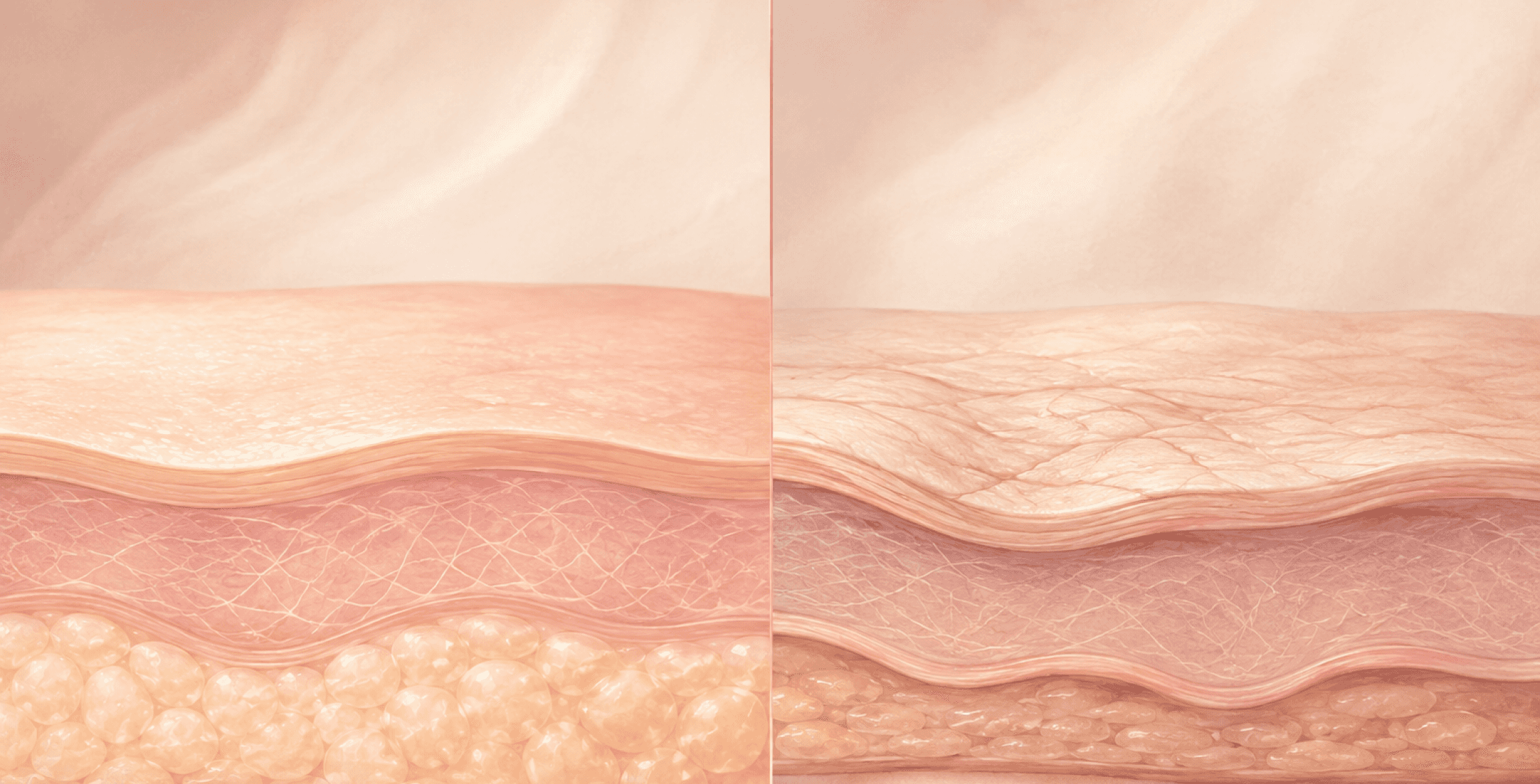
But there's a second layer. Rapid weight loss also lowers the collagen and elastin in the skin, the fibers that let it stay firm and snap back. With fewer of those fibers and less to fill it, skin can't retract quickly enough, so it reads thin and crinkled. Dermatologists note this effect is more pronounced with faster loss and after 40, when skin was already carrying less collagen.
Two things make it more noticeable:
Speed. Faster weight loss gives skin less time to shrink back to its new frame, so crepiness looks sharper.
Age and menopause. Skin can lose around 30% of its collagen in the first five years of menopause. Rapid loss then lands on skin that already had less to give.
None of this is a failure of your skin. It's a cushion receding and a fiber supply running low, both at once. The surface is simply showing it.
Crepey skin, loose skin, or lost volume: which do you have?
This is the distinction at the heart of how we think at Purpleglo, so we'll be straight with you. Different changes need different help, and knowing which layer you're looking at saves a lot of wasted money and hope.
What you're seeing | What it actually is | What honestly helps |
|---|---|---|
Thin, papery, finely lined skin | Crepiness, a skin-quality change | Consistent daily care and red light therapy |
Skin that hangs or folds a little | Mild laxity, skin quality plus some structure | Care and light for quality; a clinician for true sag |
Hollows, flat cheeks, deep folds | Lost volume and structure | Fillers, biostimulators, or a skilled injector |
What you see after weight loss often has more than one layer. Each answers to a different kind of help.
Here's why this is good news. Crepiness sits at the top of that table, in the skin-quality row, and skin quality is the one layer you can genuinely move at home. If your main concern is thin, crinkled texture rather than deep hollows, you're looking at exactly the change red light is built to support.
Does red light therapy actually help crepey skin?
Yes, and this is the honest headline: crepiness is where the evidence for red light is strongest. Red and near-infrared light nudges the cells in your skin, the fibroblasts, to make more collagen and elastin. Those are the very fibers crepey skin is short on, which is why the match is so good here.
What the research actually shows
In a 2014 randomized controlled trial of 136 people, those treated with red and near-infrared light saw improved skin texture and a measurable increase in collagen density on ultrasound, compared with an untreated group. A separate 2023 study of an at-home red light device found skin firmness improved steadily over three months of use, twice a week. This is real, measured support for skin quality.
What it honestly can't do
Red light works on the skin itself, not the fat and structure beneath it. It won't refill a hollow cheek, lift a dropped jawline, or replace lost volume, those are the territory of fillers, biostimulators, or a clinician. It supports the quality of your skin, not its scaffolding. We'd rather tell you that plainly than let you buy the wrong fix.
So here's the plain read. If crepey, papery texture is what's bothering you, red light is well matched to it, and we're comfortable saying so because the evidence backs it. What it won't do is work overnight. Collagen rebuilds slowly, so this is a weeks-and-months habit, not a weekend fix. Purpleglo is a FDA-cleared device built for exactly this skin-quality layer.
What actually helps crepey skin after weight loss?
The honest answer is usually a small stack of steady habits, not one heroic fix. Here's the plain version, strongest first:
Support collagen and elastin with red light. Red and near-infrared light, around 630nm and 850nm, used for roughly ten minutes at a time, a few times a week, encourages the cells that firm and smooth the skin. It's the most direct at-home tool for the crepey layer.
Feed the skin its building blocks. Enough protein gives your body the raw material for collagen and helps you hold onto muscle, which supports the shape underneath.
Moisturize and hydrate. Well-hydrated, well-moisturized skin looks plumper and less crinkled, and it holds texture better day to day.
Protect with daily SPF. Sun exposure breaks down collagen faster than almost anything else. Daily SPF slows the loss you're trying to rebuild.
Consider a retinoid. Over weeks, topical retinoids can support skin thickness and texture. Ask your dermatologist what suits your skin.
Go steady where you can. A more gradual pace of weight loss, when it's an option, gives skin more time to keep up.
Notice these all work on the same timescale: weeks to months, quietly, with consistency. Crepiness didn't arrive in a day, and it settles the same slow way it came.
What red light can and can't do here
Let's be clear, because overpromising isn't our style. Red light therapy supports the quality of your skin: firmness, texture, crepiness, and tone. For crepey skin specifically, that's a genuinely well-suited job, and with consistent use over weeks, skin can look firmer and smoother and feel less papery.
What it can't do is refill lost volume, tighten true structural sag, or turn back time. It doesn't add fat or lift a dropped jaw, and it isn't a substitute for a clinician when structure is the real issue. If someone promises a light device will erase deep sagging or restore your face, that's the kind of claim we've deliberately retired. Honest expectations are part of how we do things.
When to check with a professional
Most skin change after weight loss is completely normal. Still, it's worth speaking with a dermatologist or your healthcare provider if:
you're weighing a clinical treatment and want to understand your real options
you notice a new lesion, a mole that changes, or anything that looks unusual
the skin is itchy, painful, broken, or reacting in a way that won't settle
the change is affecting how you feel day to day, and you'd like a clear plan
Your comfort and your health always come first.
Frequently asked questions
Why does skin get crepey after GLP-1 weight loss?
Because the skin lost its cushion faster than it could adapt. Rapid weight loss removes the fat that filled the skin out, and it lowers the collagen and elastin that give skin its bounce. With less support underneath and fewer springy fibers inside, the surface looks thin, finely lined, and papery. It's most common over 40.
Is crepey skin a volume problem or a skin-quality problem?
Crepiness is mostly a skin-quality problem, which is good news. It's about the thinning and texture of the skin itself, not lost cheek structure. That distinction matters: skin quality is exactly the layer consistent care and red light therapy can support, while deep hollows or a dropped jawline are volume, which answer to fillers or a clinician.
Does red light therapy actually help crepey skin?
Yes, and crepiness is where the evidence is strongest. Red light supports the cells that make collagen and elastin, the exact fibers crepey skin is short on. A 2014 randomized trial found red and near-infrared light improved skin texture and increased collagen density, and a 2023 study of a home red light device measured firmness gains over three months.
How long does it take to improve crepey skin?
Think in weeks and months, not days. Collagen and elastin rebuild slowly, so honest timelines matter. In studies of home red light devices, measurable firmness changes showed up around four weeks and kept building through eight to twelve weeks of consistent use, roughly three to five short sessions a week. Consistency beats intensity.
Will crepey skin from weight loss go away on its own?
Mild crepiness can soften as your skin slowly adapts, especially if the weight settles and you support it well. But skin that thinned with age and rapid loss usually won't fully bounce back without help. Supporting collagen and elastin with consistent care, red light, protein, and daily SPF gives it the best chance to look firmer over time.
Honest light.
A note from Purpleglo: We make honest, at-home red light therapy for the skin changes that come with weight loss. Crepey, papery texture is exactly what the light is built to support, meaning firmness, texture, and tone. What it can't do, like refilling lost volume, we'll always say plainly.
Sources
Wunsch A, Matuschka K. "A Controlled Trial to Determine the Efficacy of Red and Near-Infrared Light Treatment in Patient Satisfaction, Reduction of Fine Lines, Wrinkles, Skin Roughness, and Intradermal Collagen Density Increase," Photomedicine and Laser Surgery, 2014 (PMC3926176). Retrieved 2026-07-30. https://pmc.ncbi.nlm.nih.gov/articles/PMC3926176/
"Efficacy of a home-use 630 nm LED device on skin firmness and sagging," Skin Research and Technology, 2023 (doi:10.1111/srt.13391). Retrieved 2026-07-30. https://doi.org/10.1111/srt.13391
Cleveland Clinic, "Ozempic Face: Why It Happens and What You Can Do." Retrieved 2026-07-30. https://health.clevelandclinic.org/ozempic-face
American Academy of Dermatology, "Red Light Therapy: Effective for Wrinkles and Other Signs of Aging?" Retrieved 2026-07-30. https://www.aad.org/public/cosmetic/safety/red-light-therapy
Brincat M, et al. "Skin collagen changes related to age and hormone replacement therapy," Maturitas / connective-tissue aging reviews. Retrieved 2026-07-30. https://pubmed.ncbi.nlm.nih.gov/10656502/


