Can a Red Light Mask Help Ozempic Face? Honest Answer
GLP-1 users losing 10 kg may see 7% midface volume drop in 2026. Learn what Ozempic face is and how a 630 nm LED mask supports skin, not fat.
15 min read · 3034 words
read
In 2026, glucagon-like peptide-1 receptor agonists account for more than 7% of all prescriptions in the United States, according to Truveta Research’s December 2025 monitoring report. Millions of people are losing weight on Ozempic, Wegovy, and Mounjaro. Many also notice a hollower, older-looking face. That shift has a nickname: Ozempic face.
You are not imagining it. Rapid fat loss changes facial structure. The good news? A red light therapy mask cannot replace lost cheek volume. It can support the skin that remains. This guide explains what Ozempic face is, what LED masks actually do, and how to use one safely alongside weight-loss injections.For broader context on facial changes during rapid slimming, see the Cleveland Clinic overview of Ozempic face or jump to our step-by-step LED protocol below.
Key Takeaways - In 2026, patients on GLP-1 drugs lose roughly 7% of midfacial volume for every 10 kg of body weight lost, mostly from superficial fat pads (Sharma et al., Otolaryngol Head Neck Surg, 2025). - Ozempic face describes gaunt cheeks, sunken eyes, and jowls from rapid subcutaneous fat loss. It is not a formal medical diagnosis. - Red light therapy masks improve skin quality (collagen, fine lines, texture) but do not restore lost facial fat. - A 2025 randomized trial found 86.2% of users improved crow’s feet with a 630 nm + 850 nm home LED mask versus 16.7% on sham (Park et al., Medicine, 2025). - Combine LED sessions with slow weight loss, adequate protein, and a dermatology consult for significant hollowing.
What Is Ozempic Face and Why Does It Happen on GLP-1 Drugs?
In 2026, Vanderbilt researchers quantified what dermatologists had been seeing in clinics for years. For every 10 kg of total weight lost on a GLP-1 receptor agonist, patients experienced an average 7% reduction in midfacial volume, according to Sharma et al. in Otolaryngol Head Neck Surg (2025). Superficial fat compartments dropped 11%. Deep compartments fell 7%, a change that did not reach statistical significance.
Ozempic face is the popular term for facial hollowing, laxity, and accelerated aging linked to GLP-1 medications like semaglutide (Ozempic, Wegovy) and tirzepatide (Mounjaro). Dermatologist Dr. Paul Jarrod Frank coined the phrase in 2023. It is not an official diagnosis. Your endocrinologist will not find it in a prescribing insert.
The face carries two major fat layers: superficial pads under the skin and deeper structural fat. GLP-1 weight loss appears to drain the superficial layer first. That pattern differs from normal aging, where deeper compartments often shrink more. A 2025 review in J. Clin. Med. reported that 65% of GLP-1 patients noticed facial volume loss, especially after losing more than 10% of body weight in under six months.
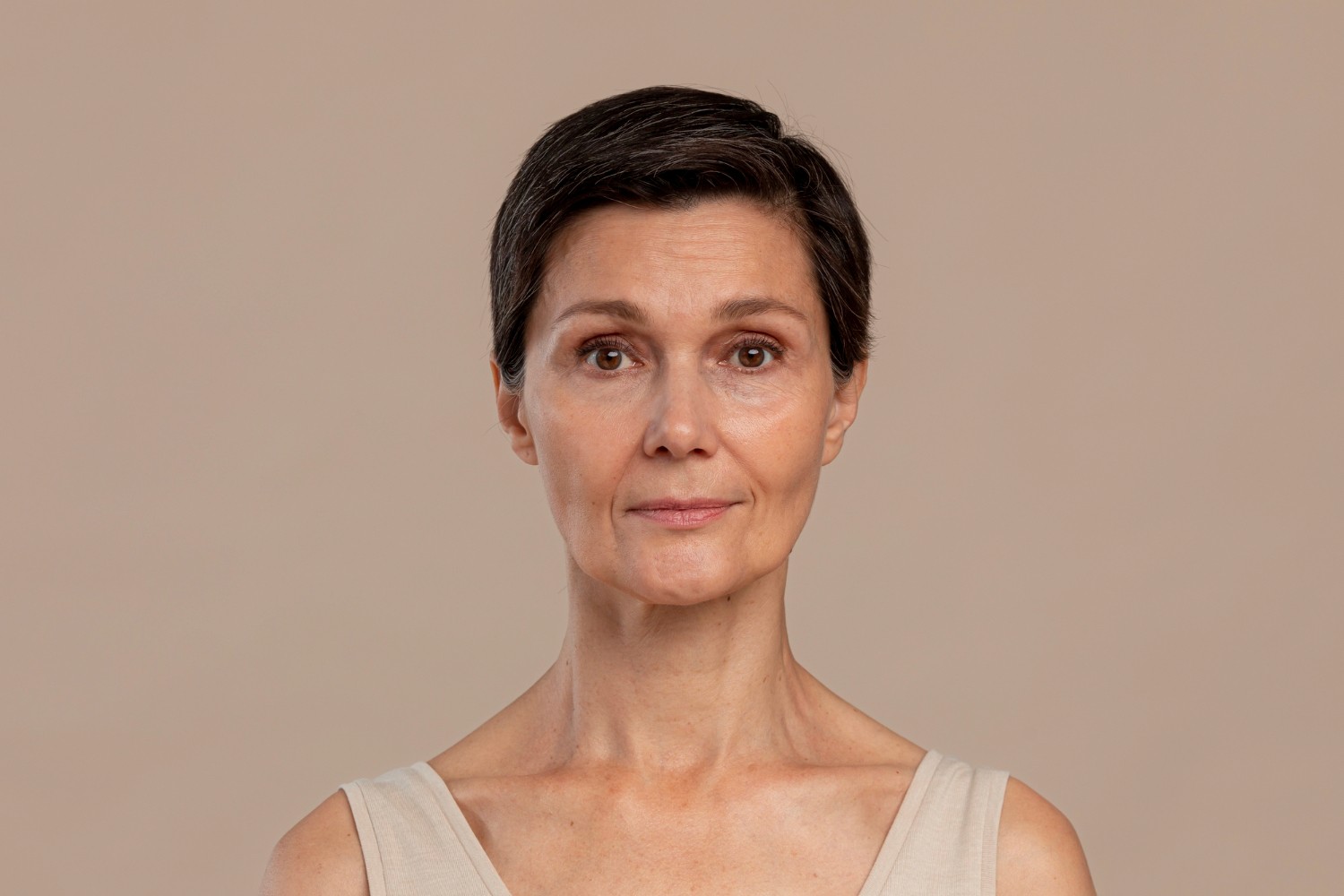
Why does your face look older so fast? Subcutaneous fat acts like internal scaffolding. Remove it quickly and skin cannot contract in time. Temples hollow. Tear troughs deepen. Nasolabial folds sharpen. Jowls appear. Cleveland Clinic endocrinologist Vinni Makin, MD, describes gaunt cheeks, new wrinkles, and loose neck skin as hallmarks of the effect.
Most social posts skip an important nuance: Ozempic face is not unique to semaglutide. Any rapid weight loss, whether from bariatric surgery, crash dieting, or other GLP-1 drugs, can produce similar changes. GLP-1 receptors also exist in skin cells, which may add a hormonal layer beyond simple fat depletion (Montecinos, Dermatological Reviews, 2024).
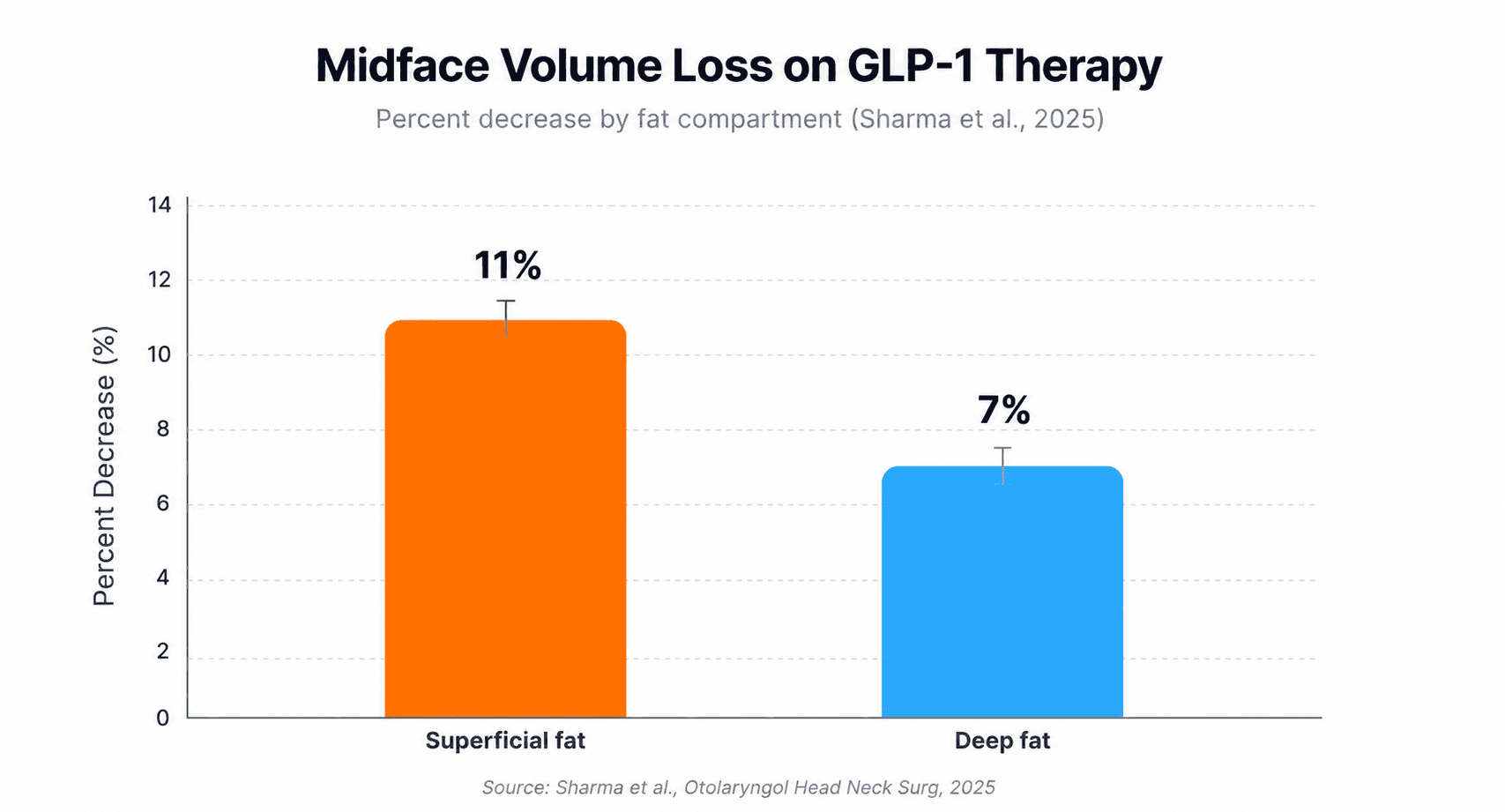
Source: Sharma et al., Otolaryngol Head Neck Surg, 2025
Sharma et al. found that superficial midface volume loss reached statistical significance while deep fat loss did not. That asymmetry helps explain why cheeks look deflated before the jawline catches up. For a clinical review of semaglutide’s dermatologic effects, see Cosmoderma’s brief on GLP-1 and skin health.
Can Red Light Therapy Actually Help Ozempic Face?
In 2026, the honest answer is partial yes. Red light therapy masks address skin remodeling. They do not refill hollow cheeks. Ozempic face is primarily a volume problem. LED photobiomodulation is a skin-quality solution. Understanding that distinction saves you months of misplaced expectations.
Red wavelengths between 620 and 660 nanometers penetrate into the dermis. There they stimulate fibroblasts, the cells that produce collagen and elastin. Near-infrared light at 810 to 850 nm reaches deeper dermal layers. It reduces inflammation and supports tissue repair. A landmark split-face trial by Lee et al. (J. Photochem. Photobiol. B, 2007) reported a 36% decrease in wrinkle depth and a 19% elasticity increase after 633 nm and 830 nm LED treatments.
What does that mean for someone on Wegovy? Your skin may look smoother, firmer, and less crepey. Fine lines around the eyes and mouth can soften. Pores may appear tighter. Overall radiance often improves. What will not happen? Cheek volume returning. Subcutaneous fat does not regrow because you wore a photobiomodulation device for twelve weeks.
Our framing: Ozempic face is two problems stacked together: structural volume loss plus skin that cannot keep pace. A red light mask targets only the second layer. Treat it as skin maintenance during weight loss, not a filler replacement.
Aesthetic research adds context. In a pilot study cited in Aesthetic Surgery Journal (2025), patients with massive weight loss appeared 5.1 years older than their chronological age during blinded evaluation. Red light will not reverse that gap alone. It can improve the skin surface riding over depleted fat pads.
Wunsch and Matuschka documented statistically significant increases in intradermal collagen density after red and near-infrared light courses (Photomed. Laser Surg., 2014). That collagen boost matters when GLP-1 therapy may suppress fibroblast activity and estrogen-linked skin support (MDPI Cosmetics, 2025). Think of LED therapy as supporting the fabric, not restoring the stuffing.
What Does the Science Say About Red Light Therapy Masks?
In 2026, the strongest home-device evidence comes from a multi-center randomized controlled trial published in Medicine. Park et al. (2025) tested a mask combining 630 nm red LED and 850 nm near-infrared light on 60 adults with crow’s feet. Participants used the device nine minutes per session, five days weekly, for twelve weeks.
Independent raters recorded an 86.2% improvement rate in the active group versus 16.7% in the sham group at twelve weeks. Global aesthetic scores improved at weeks 8, 12, and 16. No serious adverse events occurred. The authors concluded that 630 nm and 850 nm phototherapy is effective, safe, and well tolerated for skin rejuvenation.
Will every consumer device replicate that trial? Unlikely. Wavelength accuracy, irradiance, and beam uniformity vary widely between brands. A 2025 editorial in Forum Dermatologicum noted that while laboratory studies show fibroblast proliferation and collagen gains, clinical human results remain inconsistent across devices and protocols.
Complementary 2025 data supports multi-wavelength approaches. Yi et al. (Lasers Med. Sci., 2025) found that combining yellow (570 or 590 nm), red (620 nm), and infrared (850 nm) LED reduced wrinkle and brown-spot scores after eight weeks in 28 participants. A 2026 periorbital trial using 780 nm near-infrared microneedle patches reported 16.3% wrinkle-roughness improvement after four weeks (J. Mater. Chem. B, 2026).
The takeaway for mask shoppers is specific. Look for published wavelengths near 630 nm red and 850 nm near-infrared. Match the trial protocol: short daily sessions, three to five times per week, for at least eight to twelve weeks. Results fade when you stop, so maintenance sessions matter.
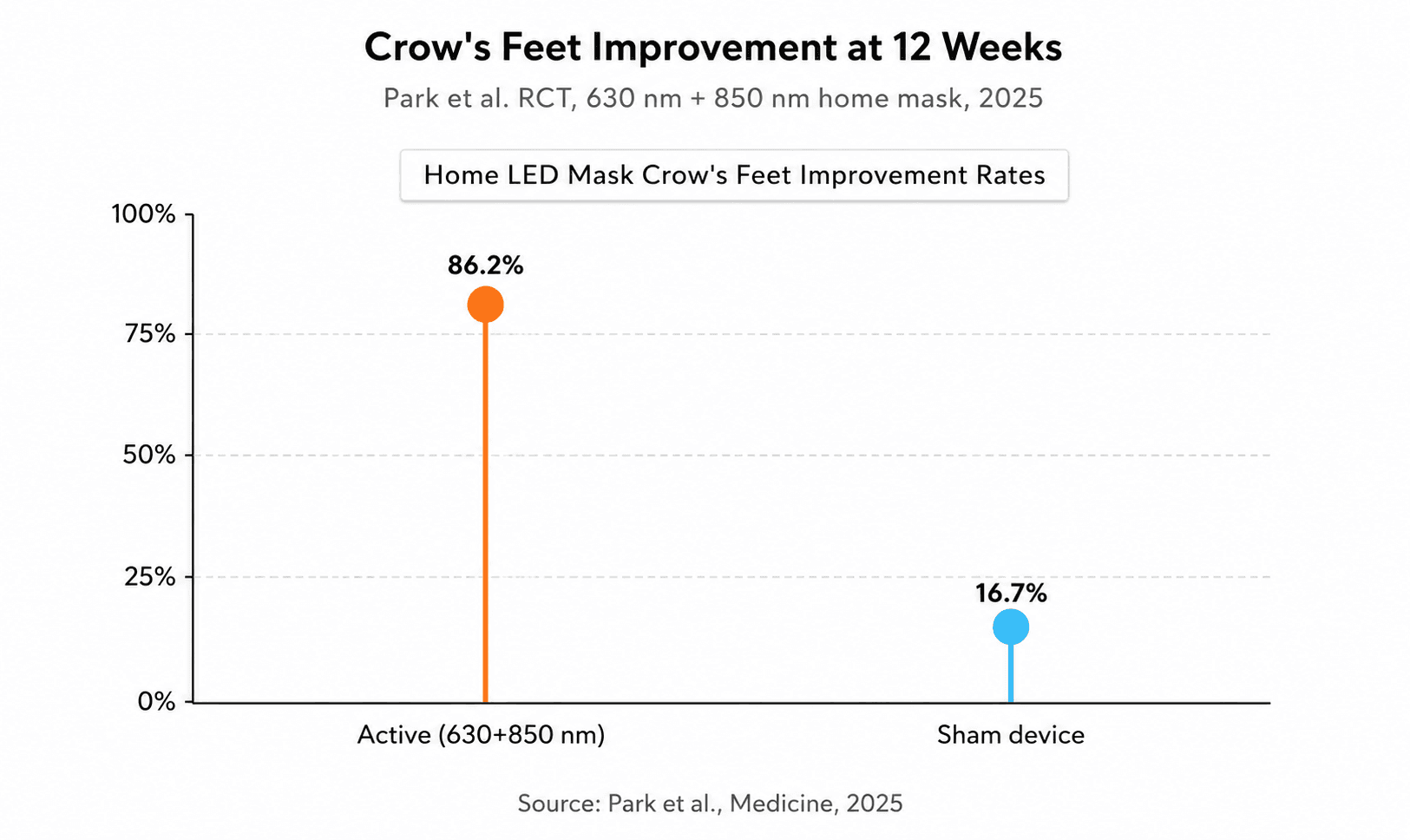
Source: Park et al., Medicine, 2025
How to Use a Red Light Therapy Mask for Ozempic Face: Step-by-Step
Ready to add an LED mask to your routine? Follow these six steps. Each one is grounded in clinical trial protocols and dermatology guidance for GLP-1 patients.
Step 1: Talk to Your Prescriber First
By the end of this step, you will have clearance to start LED therapy alongside your GLP-1 medication. Tell your endocrinologist or primary care provider about facial changes. Ask whether red light therapy fits your treatment plan. Most GLP-1 patients can use LED masks, but photosensitizing medications or active laser treatments may require a pause.
Step 2: Choose a Mask With Trial-Matched Wavelengths
Select a device emitting approximately 630 nm red light and 850 nm near-infrared light. These are the wavelengths Park et al. tested in their 2025 RCT. Check the manufacturer’s irradiance specs. Clinical devices in the trial delivered up to 10 mW/cm². Avoid masks that list only “red light” without nanometer data.
Step 3: Set a Realistic Protocol
Use the mask nine to twelve minutes per session. Schedule three to five sessions weekly. Plan for a minimum eight- to twelve-week course before judging results. The Park trial continued to sixteen weeks. Improvement often accelerates after week eight. Consistency beats intensity.
Step 4: Support Your Skin From the Inside
Red light works better when your body has building blocks available. Cleveland Clinic recommends losing one to two pounds per week to reduce facial aging effects. Aim for 1.2 to 1.6 grams of protein per kilogram of body weight daily. Stay hydrated. Rapid GLP-1 weight loss without adequate nutrition worsens skin quality (MDPI Cosmetics, 2025).
Practical tracker: Photograph your face in identical lighting at weeks 0, 4, 8, and 12. Side-by-side images reveal subtle texture gains that daily mirror checks miss. We recommend a neutral background and no makeup for consistency.
Step 5: Layer Complementary Skincare
Apply a gentle cleanser before your session. Use the mask on clean, dry skin unless the manufacturer says otherwise. Afterward, apply a peptide or hyaluronic acid serum. Finish with SPF 30+ every morning. LED therapy does not replace sun protection.
Step 6: Know When to Escalate to a Dermatologist
If hollowing is severe (sunken temples, deep tear troughs, pronounced jowls), schedule a board-certified dermatologist visit. Fillers, biostimulators like Sculptra, and fat transfer address volume loss that masks cannot touch. LED therapy pairs well as ongoing skin maintenance after professional treatment.
For protein guidance during weight-loss injections, review the Cleveland Clinic prevention tips for Ozempic face and our common mistakes section.
What Else Helps Ozempic Face Beyond Red Light?
A red light therapy mask is one tile in a larger mosaic. Volume loss demands a multimodal plan. Skin support alone rarely satisfies patients with significant facial hollowing.
Slow the pace of weight loss. Dr. Makin at Cleveland Clinic advises targeting one to two pounds per week. Faster loss increases the odds of gaunt cheeks and neck laxity. Your prescriber can adjust dosing to smooth the curve.
Prioritize protein and micronutrients. Collagen synthesis requires amino acids, vitamin C, and zinc. Skipping meals on GLP-1 appetite suppression starves your skin along with your waistline.
Consider professional aesthetic options. Dermatologists may recommend hyaluronic acid fillers for selective volume restoration. Poly-L-lactic acid (Sculptra) stimulates collagen over months. Fat grafting addresses deeper hollowing in advanced cases. A 2025 Aesthet Surg J study found combined PLLA and HA fillers improved facial harmony in GLP-1 medication users.
Use LED as maintenance, not monotherapy. Expert reviewers note that red light softens fine lines but does not lift jowls or replace subcutaneous fat. It excels as a team player in a broader device or treatment routine.
When should you skip the mask and book a consult instead? If friends say you look exhausted despite adequate sleep, or if hollow cheeks appeared within weeks of aggressive dosing, volume intervention may be the priority. LED can follow once your treatment plan stabilizes.
What Mistakes Should You Avoid With LED Masks for Ozempic Face?
Expecting fat to return. Masks stimulate collagen. They do not regrow subcutaneous fat pads. Sharma et al. measured an 11% superficial fat decrease on GLP-1 therapy. No home device reverses that structural change.
Buying unverified devices. Wavelength labels without third-party testing often mislead. Irradiance below clinical thresholds produces little dermal effect. Research the brand’s clinical data before spending $200 to $600.
Inconsistent use. The Park trial required five sessions weekly for twelve weeks. Using a mask once a week for a month, then quitting, will not replicate published outcomes.
Ignoring nutrition. GLP-1 appetite suppression makes undereating easy. Skin quality declines when protein intake drops, compounding Ozempic face severity.
Delaying professional help. Significant hollowing rarely resolves with topical or light-based home care alone. Early dermatology input prevents months of frustration.
What we tell readers: Start the mask early in your weight-loss journey as preventive skin support. Waiting until volume loss is severe leads to disappointment. The mask improves the canvas; it does not repaint the frame.
Frequently Asked Questions
Is Ozempic face permanent?
Not necessarily. Some facial changes soften if weight stabilizes and nutrition improves. Structural fat loss from rapid GLP-1 therapy may persist without professional volume restoration. In 2026, a Vanderbilt study linked each 10 kg lost to roughly 7% midface volume reduction (Sharma et al., 2025). Slower weight loss reduces severity. Read the PMC review on nonsurgical aesthetic treatment after GLP-1 weight loss for recovery context.
How long before a red light mask shows results?
Most clinical trials report visible changes between eight and twelve weeks. Park et al. (2025) measured significant crow’s feet improvement at weeks 8, 12, and 16. Fine-line softening may appear earlier. Volume-related hollowing will not resolve on this timeline.
Can I use an LED mask while on Ozempic or Wegovy?
Generally yes, for most patients. Red light therapy is non-invasive and does not interact with semaglutide metabolism. Tell your prescriber first if you use photosensitizing drugs, have active skin infections, or recently underwent laser resurfacing. Pregnant or breastfeeding patients should consult a physician before starting.
Red light mask vs filler for Ozempic face: which is better?
They solve different problems. Fillers and biostimulators restore volume in hollow cheeks and temples. Red light masks improve skin texture, collagen density, and fine lines. For moderate Ozempic face, many dermatologists combine both: volume correction plus ongoing LED maintenance.
What wavelengths should I look for in a mask?
Target 630 nm red light and 850 nm near-infrared light. These match the Park et al. (2025) RCT protocol. Some multi-wavelength devices add yellow (570 to 590 nm) for tone and blue (415 nm) for acne. Red plus near-infrared remains the core rejuvenation pairing. See the Forum Dermatologicum LED device review for buying guidance.
Conclusion
Ozempic face is real, measurable, and increasingly common as GLP-1 prescriptions exceed 7% of all U.S. scripts. A red light therapy mask will not refill hollow cheeks. It can strengthen the skin draped over a changing face.
Start with prescriber clearance. Choose a 630 nm + 850 nm device. Commit to twelve weeks of consistent sessions. Pair LED with slow weight loss, adequate protein, and professional care when volume loss is significant. Your face reflects both what you lost and how well your skin adapts.
Ready to build your routine? Bookmark this guide and revisit the science section before choosing a device.
About the author: Purpleglo Wellness Editorial is a health and beauty writing team focused on evidence-based skincare guides. Content is reviewed for medical accuracy against peer-reviewed sources. This is not a substitute for personalized medical advice.
Medical disclaimer: This article is for informational purposes only and does not constitute medical advice. Consult your physician before starting or changing any GLP-1 medication, skincare device, or aesthetic treatment.
Sources
Truveta Research, GLP-1 RA Prescription Trends December 2025 monitoring report, retrieved 2026-06-17, https://www.truveta.com/blog/research/glp-1-ra-prescription-trends-december-2025/
Sharma RK et al., Radiographic midfacial volume changes in patients on GLP-1 agonists, Otolaryngol Head Neck Surg, 2025, retrieved 2026-06-17, https://pubmed.ncbi.nlm.nih.gov/40407186/
MDPI, Functional and aesthetic periorbital changes linked to GLP-1 receptor agonists, J. Clin. Med., 2025, retrieved 2026-06-17, https://www.mdpi.com/2077-0383/14/24/8792
Cleveland Clinic, What is Ozempic face and how to prevent it, retrieved 2026-06-17, https://health.clevelandclinic.org/ozempic-face
Park SH et al., Home-used LED and IRED mask for crow's feet RCT, Medicine, 2025, retrieved 2026-06-17, https://pubmed.ncbi.nlm.nih.gov/39960921/
Lee SY et al., LED phototherapy for skin rejuvenation, J. Photochem. Photobiol. B, 2007, retrieved 2026-06-17, https://pubmed.ncbi.nlm.nih.gov/17566756/
Wunsch A & Matuschka K, Red and near-infrared light collagen density trial, Photomed. Laser Surg., 2014, retrieved 2026-06-17, https://pubmed.ncbi.nlm.nih.gov/24286286/
Montecinos K, Semaglutide Ozempic face and cosmetic dermatology, Dermatological Reviews, 2024, retrieved 2026-06-17, https://onlinelibrary.wiley.com/doi/abs/10.1002/der2.70003
Yi S et al., Yellow plus red plus infrared LED for photoaging, Lasers Med. Sci., 2025, retrieved 2026-06-17, https://link.springer.com/article/10.1007/s10103-025-04659-6
Koperdowska M, LED photobiomodulation in dermatology review, Forum Dermatologicum, 2025, retrieved 2026-06-17, https://journals.viamedica.pl/forum_dermatologicum/article/view/111321
MDPI, Cosmetic considerations of semaglutide, Cosmetics, 2025, retrieved 2026-06-17, https://www.mdpi.com/2079-9284/12/5/221
PMC, Nonsurgical aesthetic treatment in GLP-1 weight loss patients, 2025, retrieved 2026-06-17, https://pmc.ncbi.nlm.nih.gov/articles/PMC12937588/