
Why Do My Nasolabial Folds Look Deeper After GLP-1 Weight Loss?
The weight came off, and then the two lines running from your nose to the corners of your mouth seemed to arrive out of nowhere, deeper than you remember them.
10 minutes
read
You've probably known the name for years: nasolabial folds, the creases that run from either side of your nose down to the corners of your mouth. Everyone has them to some degree. But after GLP-1 weight loss, they can look noticeably deeper, and the change can feel like it happened overnight.
Is this normal?
Yes. It's one of the most common facial changes women mention after significant weight loss, and it isn't a sign that anything's gone wrong. This is the honest, calm guide to why nasolabial folds deepen after a GLP-1, what genuinely helps, and, just as importantly, what doesn't.
The short, honest version
Deeper nasolabial folds after GLP-1 weight loss are usually caused by lost cheek volume, not by your skin failing. When the fat pads that hold your cheeks up shrink, the cheek settles and the fold deepens. That's a structure change, and structure answers to fillers or biostimulators. Red light supports the skin quality around the fold, the crepiness and thinning, not the depth itself. This is support, not a miracle.
This article is for education and support, not medical advice. Fillers and other volume treatments are medical procedures. For anything involving injectables, or persistent concerns, talk to a board-certified dermatologist or plastic surgeon.
What are nasolabial folds, exactly?
They're the natural creases between your cheeks and your upper lip, framing the mouth. They're not wrinkles in the usual sense. A nasolabial fold is really the border where your cheek ends and your mouth area begins, and how deep it looks depends heavily on how full the cheek above it is.
That last point is the whole story here. Keep the cheek plump, and the fold stays soft. Take volume out of the cheek, and the same fold suddenly reads much deeper. Nothing new was added to your face. Something was taken away above it.
Why do they deepen after GLP-1 weight loss?
Because your face lost volume, and the cheek is where you feel it most. GLP-1 medications reduce fat across your whole body, and the face is often one of the first places it shows. The midface fat pads that hold your cheeks up shrink, the cheek settles downward, and the fold beneath it folds deeper.
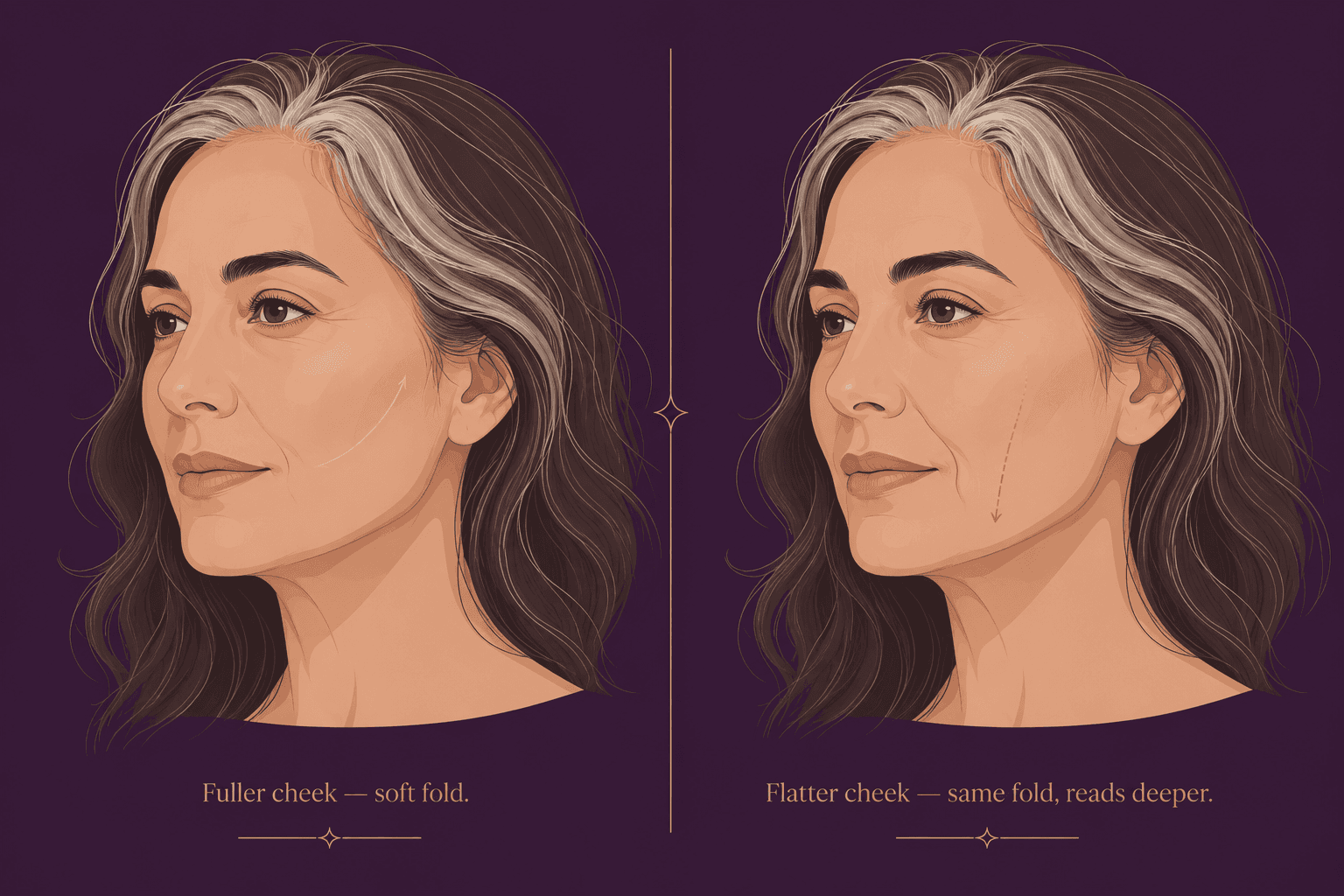
This is measurable, not just a feeling. In 2025, an imaging study of GLP-1 patients found roughly 7% of midface volume lost for every 10 kilograms of weight lost, mostly from the superficial fat pads, in a group whose median age was in the mid-50s. Less cheek support is exactly what lets a fold settle deeper.
Two things make it more pronounced:
Speed. Faster weight loss gives your face less time to adjust, and the deflation tends to look sharper.
Age. In your 40s and 50s, your cheeks were already losing some fat and firmness, so the change lands on a face with less reserve to begin with.
None of this is your skin doing something wrong. It's a support structure changing shape, and the crease is simply following it.
The honest part: is this a skin problem or a volume problem?
Mostly a volume problem, and that answer changes everything about what will actually help. This is the distinction at the heart of how we think at Purpleglo, so we'll be straight with you. Two different things can be going on around a deepened fold, and they need two different kinds of help.
What's driving it | What it actually is | What honestly helps |
|---|---|---|
The depth of the fold itself | Lost cheek volume and structure | Fillers, biostimulators, or a skilled injector |
Crepey, thinning, softening skin around it | Skin quality | Consistent daily care and red light therapy |
A deepened nasolabial fold usually has two layers. Each answers to a different kind of help.
What you can genuinely support: the skin around the fold
The firmness and texture of the skin along your cheek and mouth respond to care. Consistent habits and red light therapy, which encourages the cells that make collagen and elastin, can help the skin itself look firmer and smoother over weeks. That's a real improvement, and it's a real part of the picture.
What skincare and light honestly can't do: refill the cheek
If the fold is deep because the cheek above it lost volume, no cream, serum, or light device puts that volume back. Refilling lost cheek structure is the job of fillers, biostimulators like Sculptra or Radiesse, or a plastic surgeon. We'd rather tell you that plainly than sell you the wrong fix.
So here's the honest read. If a deep fold is your main concern and it's driven by lost cheek volume, a light device isn't your best answer, and we won't pretend it is. A board-certified injector can restore that volume and soften the fold directly. What Purpleglo is built for is the skin quality layer, the crepiness and thinning that often ride alongside, and that's a genuine, separate part of feeling like yourself again.
What actually helps deepened nasolabial folds?
It depends on which layer you're treating, and often the honest answer is a combination. Here's the plain version, strongest options first for the fold depth itself:
Restore the volume (for the depth). Hyaluronic acid fillers or biostimulators, placed in the cheek to lift it, are the direct answer to a fold caused by lost structure. This is injector territory, and worth a proper consultation.
Support the skin quality (for how the area looks and feels). Red and near-infrared light, around 630nm and 850nm, with consistent use of about ten minutes a day, supports firmness and texture in the skin around the fold. It works on quality, not depth.
Feed the collagen. Enough protein gives skin its building blocks and helps you hold muscle, which supports the shape beneath your face.
Hold onto muscle. Gentle resistance movement helps preserve the underlying structure that fullness sits on.
Protect and hydrate. Daily SPF slows collagen breakdown, and well-hydrated skin looks more resilient.
Go steady where you can. A more gradual pace of weight loss, when it's an option, gives your face more time to adjust.
Notice the order. Volume loss gets a volume answer. Skin quality gets a skin answer. Trying to fix one with the tool for the other is where a lot of money and hope get wasted.
What red light can and can't do here
Let's be clear, because overpromising isn't our style. Red light therapy supports the quality of your skin: firmness, texture, crepiness, and tone. Around a nasolabial fold, that can mean skin that looks and feels healthier and a little firmer with consistent use over weeks.
What it can't do is refill a cheek or erase a fold created by lost volume. It doesn't add structure, and it isn't a substitute for filler when structure is the real issue. If someone tells you a light device will make deep folds disappear, that's the kind of claim we've deliberately retired. Honest expectations are part of how we do things.
When to check with a professional
Most facial change after weight loss is completely normal. Still, it's worth speaking with a dermatologist or your healthcare provider if:
you're considering fillers or biostimulators and want to understand your real options
you notice a new lesion, a mole that changes, or anything that looks unusual
you have irritation, a rash, or a reaction that won't settle
the change is affecting how you feel day to day, and you'd like a clear plan
Your comfort and your health always come first.
You're not aging badly, your face is adjusting
A deeper fold after all that effort can sting, especially when you feel healthier than you have in years. But it isn't a verdict on your skin or a sign you did something wrong. Your cheeks simply hold less than they did, and the crease is following the new shape.
This was never about turning back the clock. It's about understanding what actually changed, so you can choose the fix that matches it, whether that's supporting your skin at home, restoring volume with a professional, or both. You did the hard part. Your face is simply catching up.
Frequently asked questions
Why do nasolabial folds deepen after GLP-1 weight loss?
Because you lose cheek volume. GLP-1 weight loss shrinks the midface fat pads that hold your cheeks up. When that support drops, the cheek settles downward and the crease from your nose to your mouth folds deeper. It's a change in facial structure, not a sign your skin has failed.
Are deeper nasolabial folds a skin problem or a volume problem?
Mostly a volume problem. A deep fold after weight loss is usually lost cheek structure, not surface skin. That distinction matters because volume answers to fillers or biostimulators, while the skin quality around the fold, the crepiness and thinning, is what care and red light therapy can support.
Can red light therapy get rid of nasolabial folds?
No, and we won't claim it can. Red light supports skin quality: firmness, texture, crepiness, and tone. It can't restore the lost cheek volume that makes a fold deep. If the fold is driven by lost structure, that's the territory of fillers, biostimulators, or a skilled injector, not a light device.
How much facial volume do you lose on a GLP-1?
It can be measured. A 2025 imaging study of GLP-1 patients found roughly 7% of midface volume lost for every 10 kilograms of weight lost, mostly from the superficial fat pads. Less cheek volume is exactly what lets nasolabial folds settle deeper, especially with faster weight loss.
Will my nasolabial folds go back to normal on their own?
Sometimes they soften a little as skin adapts, but a fold created by genuinely lost cheek volume usually won't fully close on its own. Supporting skin quality and holding onto muscle can help the overall look. For the volume itself, a clinical option is the honest answer.
Honest light.
A note from Purpleglo: We make honest, at-home red light therapy for the skin changes that come with weight loss. We're clear about what the light can do, meaning firmness, texture, and crepiness, and what it can't, like refilling lost cheek volume. If a fold needs a professional, we'll say so.
Sources
Sharma RK, et al. "Radiographic Midfacial Volume Changes in Patients on GLP-1 Agonists," Otolaryngology�Head and Neck Surgery, 2025 (PubMed 40407186). Retrieved 2026-07-13. https://pubmed.ncbi.nlm.nih.gov/40407186/
Westlake Dermatology, "Fix Ozempic Face: Restore Facial Volume After GLP-1 Weight Loss." Retrieved 2026-07-13. https://www.westlakedermatology.com/blog/restore-facial-volume-after-weight-loss/
"Ozempic Face: An Update and Critical Review," Journal of Clinical and Regenerative Medicine, 2025. Retrieved 2026-07-13. https://jcrm.jams.pub/article/1/2/29
"GLP-1RA and the possible skin aging," Endocrine (Springer), 2025. Retrieved 2026-07-13. https://link.springer.com/article/10.1007/s12020-025-04293-w