Hollow Cheeks vs. Loose Skin: How to Tell What You're Actually Seeing
They can look almost the same in the mirror, but they're two different changes with two different fixes, and knowing which one you have saves you a lot of money, time, and hope.
10 min
read
After GLP-1 weight loss, you look in the mirror and something in your face has changed, but you can't quite name it. Is it that your cheeks look flatter and more hollow? Or that the skin seems looser, like it's hanging a little? Those two things feel similar. They are not the same, and that difference decides what will actually help.
Why does it matter which one it is?
Because a volume problem and a skin problem answer to completely different fixes. Try to solve one with the tool made for the other, and you'll spend money and end up disappointed. This is the honest, calm guide to telling them apart, and matching each to what genuinely helps.
The short, honest version
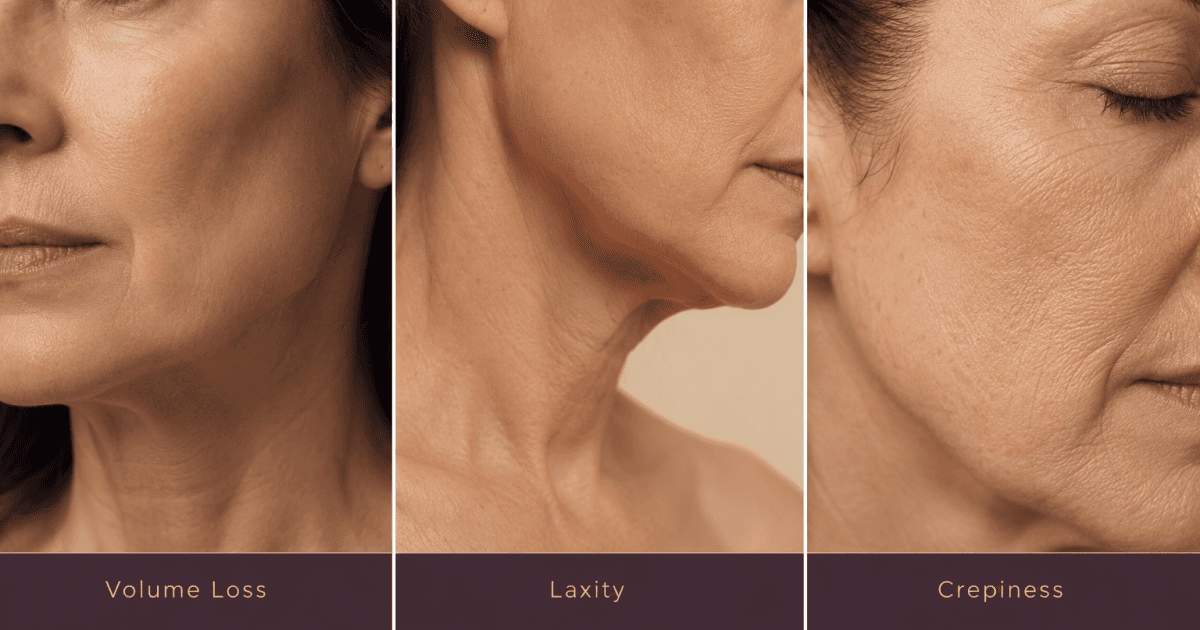
Hollow cheeks are lost volume, the fat pads shrank, leaving flatness and shadow. Loose skin is laxity, the skin lost its fill and now hangs a little. Crepiness is a third thing: thin, papery surface texture. Volume answers to fillers or biostimulators. True structural sag is a clinician's territory. Skin quality and mild laxity are where consistent care and red light genuinely help. Most faces have a mix.
This article is for education and support, not medical advice. Fillers, biostimulators, and lifts are medical procedures. For anything involving injectables, energy devices, or surgery, talk to a board-certified dermatologist or plastic surgeon.
Why telling them apart matters so much
Because the right fix follows the right diagnosis, and here the two get confused constantly. A flatter, more hollow face and a looser, softer face can look alike at a glance, especially in unforgiving light. But underneath, one is missing fill and the other is missing firmness.
This is the distinction at the heart of how we think at Purpleglo, so we'll be straight with you. Get the diagnosis right and you can choose the fix that matches. Get it wrong, and you might buy a light device for a volume problem, or book filler for skin that mostly needs support. We'd rather help you tell them apart first.
What are hollow cheeks, exactly?
Hollow cheeks are a volume problem. GLP-1 medications reduce fat throughout the body, and the face is often where it shows first. The superficial fat pads that hold your cheeks up shrink, so the midface flattens and the area beneath the cheekbone reads sunken, with new shadows. This is the change often called "Ozempic face."
The tell is flatness and shadow. Hollowing looks like something was taken away from underneath, because it was. The skin over it may still be perfectly firm. What changed is the fill beneath it, not the surface. That's why no cream or light device puts it back, the missing thing is structure.
What is loose skin, exactly?
Loose skin is laxity, a skin problem rather than a fill problem. When you lose weight quickly, the skin that stretched to cover more can be left with less to hold onto. If its collagen and elastin are also running low, it doesn't retract fully, so it softens, hangs, or folds slightly, especially along the lower face and jaw.
The tell here is movement. Loose skin shifts or drapes when you move or lie back, and you can often gently gather it between your fingers. Unlike hollowing, this is about the skin itself, its firmness and how well it snaps back, which is exactly the layer that can be supported.
And a third one people miss: crepiness
Crepiness is skin quality at the surface, thin, papery, finely lined skin, like crepe paper. It often rides alongside the other two but it's distinct. You can have crepey texture on skin that isn't especially loose, and it's the change that responds best of all to consistent care and red light.
So really there are three layers, not two. Naming yours is the whole game.
How to tell which one you have
You can get a good read in a mirror with a couple of gentle checks. None of this replaces a professional eye, but it will tell you roughly which layer you're dealing with, and therefore what to look into.
The mirror lift test (for volume vs. laxity)
In good light, gently rest two fingers on your upper cheek and lift the skin up and out toward your ear. Watch what improves.
If the hollow under your cheekbone fills in and the face looks restored, you're mostly looking at volume loss.
If the improvement is mainly skin smoothing out that was draping or folding, you're mostly looking at laxity.
The gentle gather test (for laxity vs. quality)
Can you softly gather loose skin between your fingers along the jaw? That points to laxity.
Does the skin mostly look thin and finely lined but not really hang? That's crepiness.
The light test
Shadows and flatness that shift with the angle of light usually mean volume loss.
Softness and drape that shift when you move or lie back usually mean laxity.
Most faces, honestly, show a blend, some hollowing, a little laxity, some crepey texture. That's normal. The point isn't a perfect label. It's knowing which layer is loudest for you, so you spend on the fix that matches it.
What honestly fixes each one
Here's the plain map. Each change answers to a different kind of help, and matching them is where the money and the hope stop getting wasted.
What you're seeing | What it actually is | What honestly helps |
|---|---|---|
Flat, hollow cheeks with shadow | Lost volume and structure | Fillers or biostimulators, placed by a skilled injector |
Skin that hangs, drapes, or folds | Laxity, skin plus some structure | Care and red light for mild laxity; a clinician for true sag |
Thin, papery, finely lined skin | Crepiness, a skin-quality change | Consistent daily care and red light therapy |
Three different changes, three different fixes. Most faces have a mix, and that's normal.
What you can genuinely support at home
The quality of your skin, its firmness, texture, crepiness, and tone, responds to consistent care. Protein, hydration, daily SPF, and red light therapy, which encourages the cells that make collagen and elastin, can help skin look firmer and smoother over weeks. Mild laxity often improves here too.
What home care honestly can't do
If the main issue is a hollow cheek, no cream or light device refills lost volume, that's fillers or biostimulators. And genuinely loose, hanging skin from major weight loss is structural, which is a dermatologist or surgeon's territory, energy devices or a lift. We'd rather tell you plainly than sell you the wrong fix.
So here's the honest read. If hollowing is your loudest change, a light device isn't your answer, and we won't pretend it is, a good injector is. If crepey texture or mild laxity is what bothers you most, that's exactly where Purpleglo, a FDA-cleared device, does its real work. Knowing which is which is the whole point.
What red light can and can't do here
Let's be clear, because overpromising isn't our style. Red light therapy supports the quality of your skin: firmness, texture, crepiness, and tone. For crepey skin and milder laxity, that can mean skin that looks and feels firmer and smoother with consistent use over weeks. That's a real, honest improvement.
What it can't do is refill a hollow cheek, lift genuinely sagging skin, or add structure back to your face. It doesn't replace filler when volume is the issue, or a lift when true sag is. If someone promises a light will restore your cheeks or erase deep sagging, that's the kind of claim we've deliberately retired.
When to check with a professional
Most facial change after weight loss is completely normal. Still, it's worth speaking with a dermatologist or your healthcare provider if:
you're considering fillers, biostimulators, energy devices, or a lift and want your real options
you're not sure whether you're seeing volume loss or laxity and want an expert read
you notice a new lesion, a mole that changes, or anything that looks unusual
the change is affecting how you feel day to day, and you'd like a clear plan
Your comfort and your health always come first.
You're not aging badly, your face is adjusting
A face that looks different after all that effort can be disorienting, especially when you feel healthier than you have in years. But hollowing and loosening aren't verdicts on your skin. They're your face adjusting to a new shape, and each has a fix that fits, once you know which you're looking at.
This was never about turning back the clock. It's about understanding what actually changed, so you can choose the help that matches, whether that's supporting your skin at home, restoring volume with a professional, or both. You did the hard part. Your face is simply catching up.
Frequently asked questions
What's the difference between hollow cheeks and loose skin after weight loss?
Hollow cheeks are a volume problem: the fat pads that filled your face shrank, leaving flatness and shadow. Loose skin is a laxity problem: the skin lost its fill and now hangs or folds a little. They look similar but answer to different fixes. Volume is restored with fillers or biostimulators; skin quality and mild laxity respond to consistent care and red light.
How can I tell if I have volume loss or loose skin?
A simple test helps: gently lift the skin of your cheek up and toward your ear. If the area looks better mainly because you've refilled a hollow, that's volume loss. If the improvement comes from smoothing skin that was hanging, that's laxity. Hollowing shows as flatness and shadow; loose skin shows as skin that moves or folds. Many faces have both.
Can red light therapy fix hollow cheeks?
No, and we won't claim it can. Hollow cheeks are lost volume, and red light doesn't add fat or structure back. What red light supports is skin quality: firmness, texture, crepiness, and tone. If flatness and shadow are your main concern, that's the territory of fillers or biostimulators placed by a skilled injector, not a light device.
What helps loose skin after GLP-1 weight loss?
It depends on how much and how deep. Mild laxity and crepey texture respond to consistent care, protein, hydration, daily SPF, and red light therapy, which supports collagen and elastin. Genuinely loose, hanging skin from major weight loss is structural, and that's a conversation for a dermatologist or surgeon about energy devices or a lift.
Why does the face lose volume on a GLP-1?
Because GLP-1 medications reduce fat throughout the body, and the face is often where it shows first. The superficial fat pads that hold the cheeks up shrink, so the face flattens and hollows, an effect often called Ozempic face. It's a change in facial structure driven by fat loss, not a sign your skin failed, and it's sharper with faster loss and over 40.
A note from Purpleglo: We make honest, at-home red light therapy for the skin changes that come with weight loss. It supports skin quality, firmness, texture, and tone, and helps most with crepiness and milder laxity. What it can't do, like refilling a hollow cheek, we'll always say plainly.