

Will My Skin Bounce Back After GLP-1 Weight Loss?
You did the hard part. The number moved. And now you're standing in front of the mirror wondering whether the skin will catch up, or whether this is just how you'll look now.
10 Minutes Read
read
It's one of the most common questions we hear after GLP-1 weight loss. In 2026, a survey of 1,226 patients on GLP-1 receptor agonists found that 72% of those who lost more than 20% of body weight reported skin sagging, compared with just 15% among those who lost under 10% (Dermatology and Therapy, 2026). The question deserves a straight answer, not a hopeful one.
Will my skin bounce back? Sometimes, partly, over time. Sometimes not fully on its own. The answer depends on what actually changed, and "bounce back" can mean three very different things.
Key takeaways
How much you lose matters. In 2026, skin sagging was reported by 15% of GLP-1 patients who lost under 10% of body weight, 44% at 10-20%, and 72% above 20% (Dermatology and Therapy).
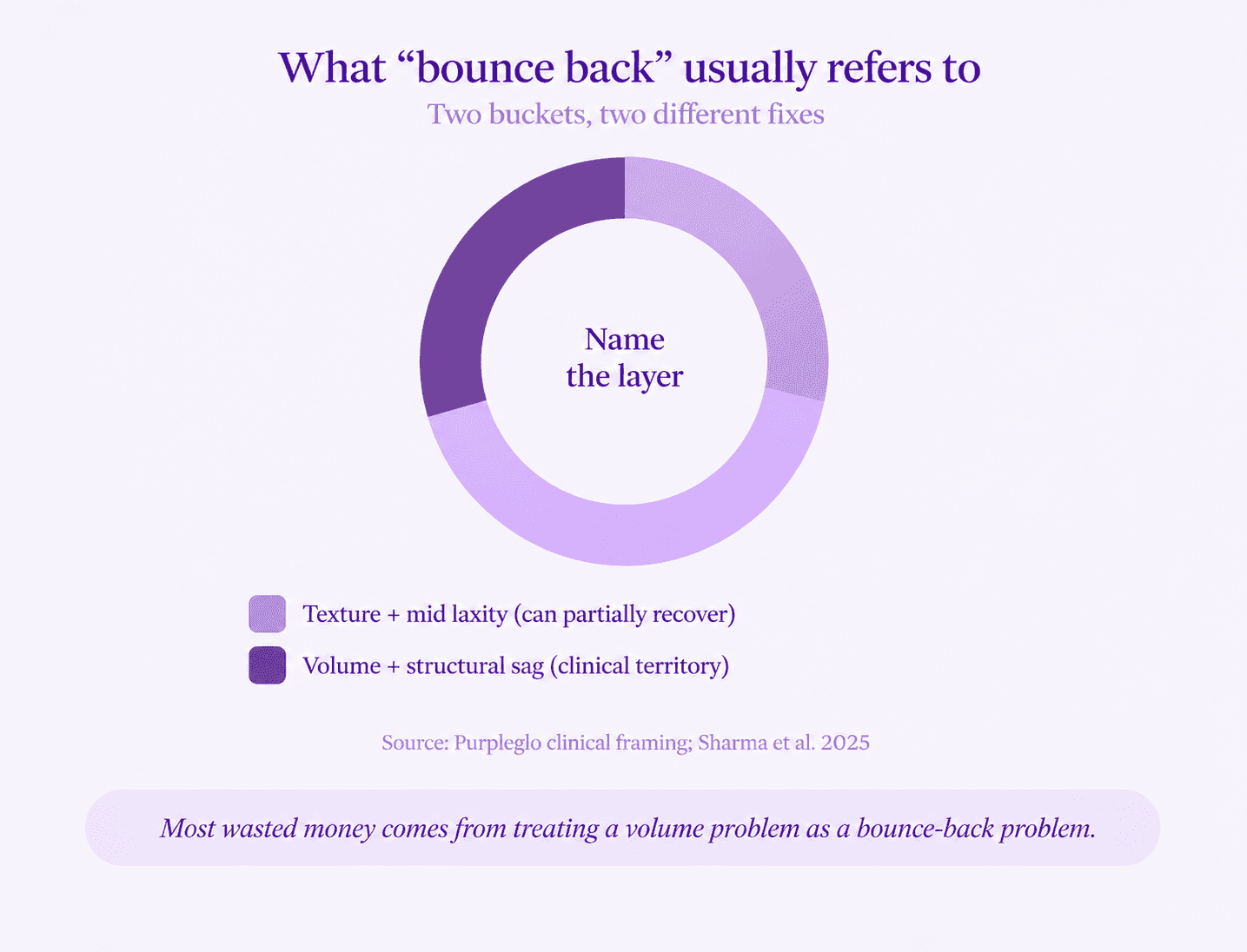
Name the layer first. Texture, laxity, and lost volume look alike but don't bounce back the same way.
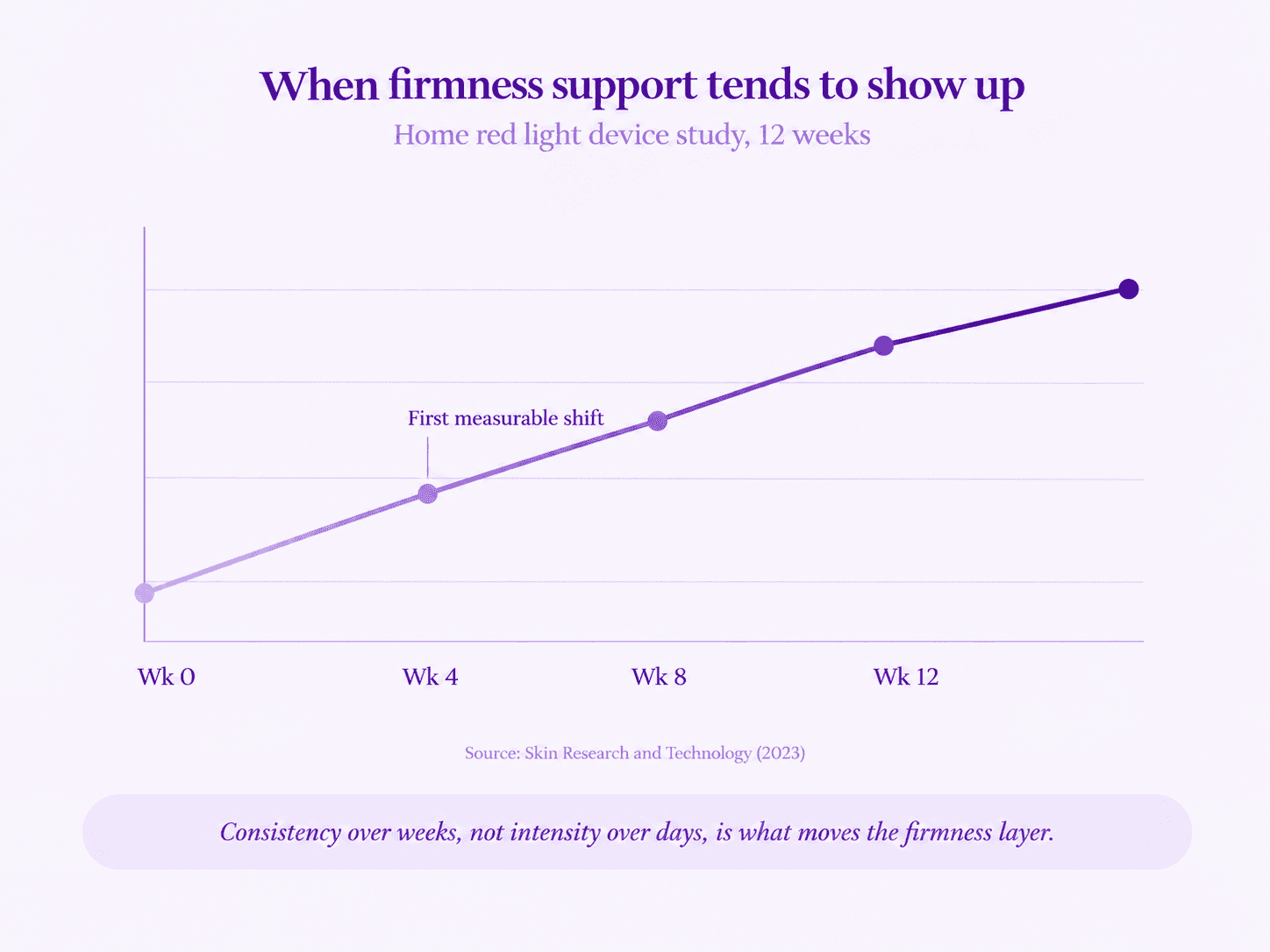
Time is real, not magic. Firmness support can show measurable gains by week 4 and build through week 12; full adaptation after major loss often takes six to twelve months.
Prevention beats rescue. Skin supported during the loss adapts far better than skin you try to fix after.
This article is for education and support, not medical advice. If a skin change is sudden, painful, or paired with other symptoms, or you're weighing a clinical treatment, talk to a board-certified dermatologist or your healthcare provider.
Will My Skin Bounce Back After GLP-1 Weight Loss?
In 2026, patient-reported skin sagging on GLP-1 therapy rose sharply with the amount lost: 15% below 10% body-weight reduction, 44% at 10-20%, and 72% above 20% (Dermatology and Therapy, 2026). The honest answer is partly. Mild laxity and crepiness can soften once weight stabilizes. Lost facial volume and true structural sag usually won't fully recover without the right kind of help.
GLP-1 medications don't directly damage skin. Cleveland Clinic dermatologists note that the same changes happen with any rapid, significant weight loss, whether from diet, surgery, or medication. The drug gets singled out because it makes large, fast loss achievable for far more people. What you're seeing is physics and biology, not a punishment for succeeding.
What Does "Bounce Back" Actually Mean?
In 2025, a radiographic study measured a median 9.0% fall in midfacial volume among patients on GLP-1 agonists (Otolaryngology–Head and Neck Surgery, Sharma et al.). That volume loss won't "bounce," because bounce implies elasticity, and hollow cheeks are a fill problem, not a spring problem. Three separate changes get lumped together:
Elastic recoil is when skin that used to snap back when pinched now feels slack or slow to return. That's laxity.
Surface texture is thin, papery, finely lined skin. That's crepiness, a collagen and elastin question.
Lost fill is deeper: hollow cheeks, flat temples, deeper folds. That's volume, the fat pads that shrank beneath the skin.
Pinch the skin on the back of your hand. Springs back quickly? Elasticity is still working. Lingers? You're looking at laxity. Face looks flatter even when the skin feels fine? Volume may be the louder change. Our volume vs. loose skin guide walks through how to tell, and it saves a lot of wasted money.

Why Doesn't Skin Always Bounce Back After Rapid Weight Loss?
In 2021, the STEP 1 trial found semaglutide 2.4 mg produced a mean 14.9% body-weight reduction over 68 weeks versus 2.4% with placebo (New England Journal of Medicine, Wilding et al.). That's a genuine health win and a skin stress test. Fat that once filled the face and body leaves faster than collagen and elastin can fully contract.
When adipose volume under the dermis shrinks faster than the fiber network can adapt, skin hangs, thins, or creases. Four variables decide how sharply you'll see it:
Speed. Faster loss gives skin less time to shrink back. When pace is an option, roughly one to two pounds a week stacks the odds.
Amount. The 2026 survey's trend was clear: more loss, more sagging reports, with P < 0.001 across all categories.
Age. Skin over 40 often starts with less collagen. Menopause can take around 30% in the first five years, so rapid loss lands on skin that already had less to give.
History. Sun damage, smoking, and genetics all affect how much recoil is left in the tank.
None of this means your skin failed. The change simply outpaced the adaptation, and adaptation, when it comes, is slow.
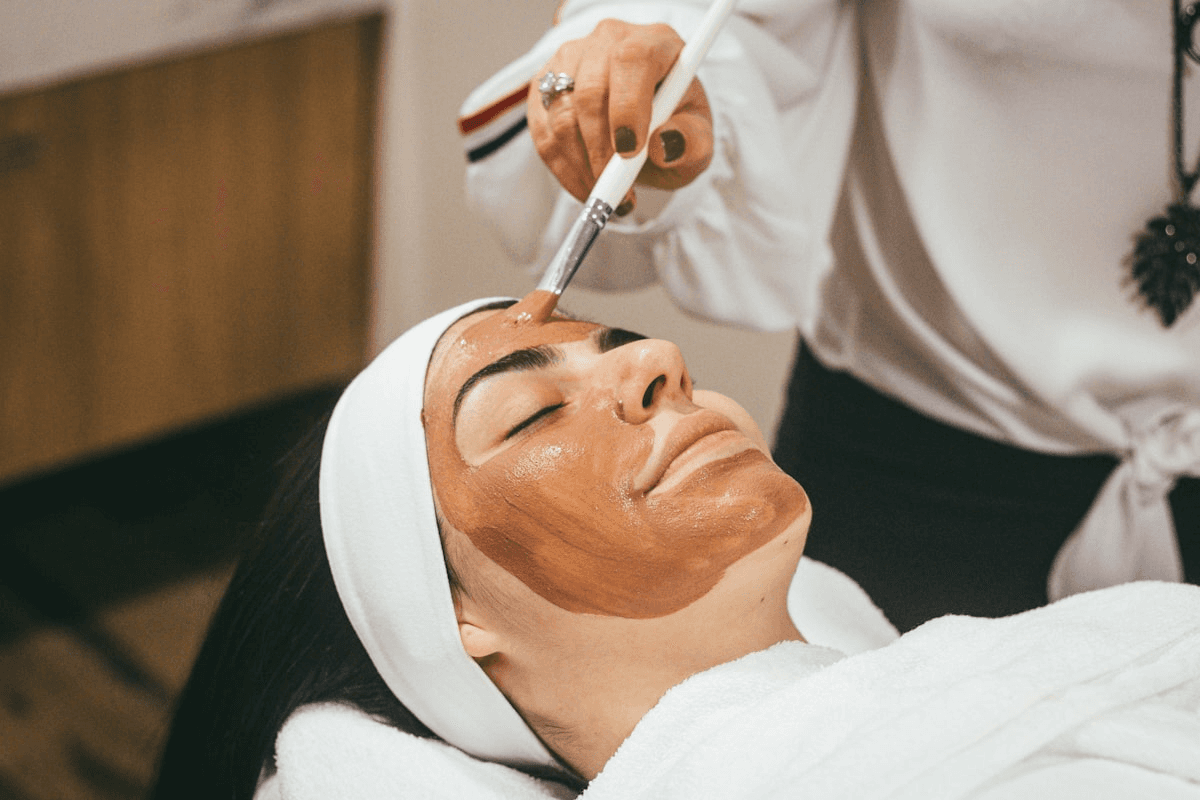
ALT: Close-up of mature skin texture: the collagen and elastin layer that determines whether skin feels springy or slack.
Which Skin Changes Can Recover, and Which Can't?
In 2023, a home red light device study measured firmness gains over 12 weeks of consistent use (Skin Research and Technology, Couturaud et al.). That matters because crepiness and mild laxity sit in the skin-quality row, the layer you can still move at home. Lost volume and true structural sag sit in a different row entirely.
What changed | Will it bounce back on its own? | What genuinely helps |
|---|---|---|
Mild laxity (less springy skin) | Often partially, over months, once weight stabilizes | Protein, resistance training, SPF, red light for firmness |
Crepey, thin texture | Mild cases can soften; deeper crepiness usually needs support | Consistent skin-quality care and red light over weeks |
Lost facial volume (hollows, flat cheeks) | No. Fat doesn't return because skin tightens | Staged filler, biostimulators, or a skilled clinician |
Significant excess skin (body or face) | Unlikely to fully retract without intervention | Clinical consultation; surgery removes skin, not adds bounce |
What you see after weight loss often has more than one layer. Each answers to different help.
How Long Should You Wait Before Deciding It Won't Bounce Back?
In 2023, measurable firmness changes from a home red light device appeared around week 4 and kept building through week 12 (Skin Research and Technology). Collagen and elastin rebuild on that same patient timescale, which means judging your final result while you're still actively losing is premature.
While you're still losing: skin is chasing a moving target. Wait.
After weight stabilizes: give it several months before calling it structural.
For at-home firmness support: think in 4-12 week cycles of consistent use, not weekend fixes.
For overall adaptation after major loss: six to twelve months is a reasonable window.
Six months past stable weight and the main issue is hollowing or hanging skin? That's probably a volume or clinical question, not a patience question. Track texture, firmness, and fullness separately with our GLP-1 skin journal; the distinction becomes obvious fast.
Plastic surgeons see the volume-vs-laxity distinction daily. Filler can't fix hanging skin, and surgery can't restore spring.
What Actually Helps Skin Bounce Back?
In 2025, a joint advisory from four US nutrition and obesity societies recommended 1.2 to 1.6 g of protein per kilogram of body weight daily during GLP-1 weight loss (American Journal of Clinical Nutrition). Protein gives your body collagen's raw materials and helps preserve muscle, which supports the shape beneath your skin. Without resistance training, though, the advisory is explicit: protein alone won't hold muscle.
There's no single miracle. There's a stack of steady habits that work on the layers skin can still adapt:
Let weight settle first. Skin can't fully adapt to a shape that's still changing.
Keep protein high and lift weights. Muscle keeps the frame looking firmer at the new weight. See our muscle retention guide.
Wear daily SPF. Sun breaks down collagen faster than almost anything you're trying to rebuild.
Start early if you're still losing. Our prevention guide covers the start-before-the-sag habits.
Support skin quality with red light. Red and near-infrared light encourage the fibroblasts that make collagen and elastin, the fibers lax, crepey skin is short on.
Go steady where you can. A more gradual pace, when it's an option, gives skin more time to keep up.
Notice the pattern? None of these promise overnight bounce. They all work quietly, with consistency, on the skin-quality layer.
Where Does Red Light Fit, and Where Doesn't It?
In 2025, a photobiomodulation consensus in the Journal of the American Academy of Dermatology graded these devices as supported for skin rejuvenation at evidence level IB (Maghfour et al.). For firmness, texture, crepiness, and tone, the "bounce" people actually mean, that's a well-matched job.
What red light can support
Firmness, texture, crepiness, and tone. A 2014 randomized trial of 136 people found red and near-infrared light improved skin texture and increased collagen density on ultrasound. A 2023 home-device study measured firmness gains over three months. This is measured support for skin quality, not lost scaffolding.
What red light honestly can't do
Restore lost facial volume. Lift true structural sag. Remove hanging skin. Refill a hollow cheek. The 2025 JAMA Dermatology consensus lists no volume claim anywhere in the photobiomodulation literature. If someone promises a mask will make everything bounce back, that's a claim we've deliberately retired.
Purpleglo is an FDA-cleared at-home device built for the skin-quality layer. It's the honest match when bounce means "my skin feels less springy" or "my texture looks crepey," not when bounce means "my cheeks are hollow."

Dermatologists report rising demand for skin tightening since GLP-1s, because fat loss and skin adaptation don't move at the same speed.
Does Face Skin Bounce Back the Same Way as Body Skin?
In 2025, Sharma et al. measured a median 9.0% midfacial volume drop in patients on GLP-1 agonists, concentrated in superficial fat just beneath the skin. On the face, you're often dealing with two layers at once: skin quality and lost volume. A volume drop doesn't bounce back because you moisturize harder. Our GLP-1 face guide breaks down all four changes people lump together.
On the abdomen, arms, and thighs, there's no cheekbone fat pad to refill. The question is simpler: how much excess skin is there, and did it retract? When it didn't, the honest options are clinical, and for significant excess, that usually means procedures that remove skin. Our cost guide lays out what those paths actually run.
ALT: Consistent daily skin habits (SPF, hydration, protein) work on the same slow clock as collagen turnover.
When Should You Talk to a Professional?
Most skin change after weight loss is normal. It's still worth a conversation with a dermatologist or plastic surgeon if you're past stable weight and the main issue is hollowing, deep folds, or hanging skin, or if you're weighing filler, biostimulators, or surgery and want a staged plan.
Knowing what won't bounce back on its own isn't giving up. It's choosing the right help instead of the wrong one. A board-certified clinician can tell you in one visit whether you're looking at texture, laxity, volume, or all three, and in what order to address them.
You're not waiting for a miracle. You're waiting for the right layer
The question "will my skin bounce back?" usually hides a more specific one: will I look like myself again? Maybe. Probably not identically. But the parts that can adapt, like texture, firmness, and mild laxity, do respond to time and consistent support.
The parts that can't, like lost volume and true structural sag, have their own honest answers. You did something hard for your health. Your skin is catching up on a slower clock. Understanding which layer you're looking at is how you stop buying the wrong fix and start supporting the right one.
Frequently asked questions
Will my skin bounce back after GLP-1 weight loss?
Partly, and it depends on what changed. In a 2026 survey of 1,226 GLP-1 patients, skin sagging was reported by 15% of those who lost under 10% of body weight, 44% at 10-20%, and 72% above 20%. Mild laxity and crepiness can soften once weight stabilizes. Lost facial volume and true structural sag usually won't fully bounce back without clinical help.
How long does it take for skin to tighten after weight loss?
Give it months, not weeks, after your weight has settled. In a 2023 home-device study, measurable firmness gains appeared around week 4 and kept building through week 12. Overall adaptation after major loss often takes six to twelve months. A full return to your pre-loss look isn't guaranteed.
Does losing weight slowly help skin bounce back?
Yes, when it's an option. Cleveland Clinic dermatologists recommend gradual loss because fat leaves throughout the body faster than skin can retract. A pace of roughly one to two pounds a week gives collagen and elastin more time to adapt. Your medical plan comes first, so discuss pace with your prescriber.
Can red light therapy make loose skin bounce back?
Red light supports skin quality (firmness, texture, crepiness, and tone) by encouraging collagen and elastin production. A 2025 JAMA Dermatology consensus graded photobiomodulation at evidence level IB for skin rejuvenation. It won't restore lost volume, lift true structural sag, or remove hanging skin.
Why doesn't skin bounce back after rapid weight loss?
Because the skin lost its cushion faster than it could adapt. In STEP 1, semaglutide produced 14.9% mean weight loss over 68 weeks. When fat recedes faster than collagen and elastin can contract, skin reads slack, thin, or crepey, especially over 40, when collagen was already declining.
Sources
Skin Impacts and Tradeoffs of GLP-1 Therapy: Improved Patient-Reported Outcomes of Inflammatory Skin Disease in the Era of "Ozempic Face." Dermatology and Therapy, 2026. Retrieved 2026-09-12. https://link.springer.com/article/10.1007/s13555-026-01882-z
Wilding JPH et al. "Once-Weekly Semaglutide in Adults with Overweight or Obesity." New England Journal of Medicine, 2021;384(11):989–1002. Retrieved 2026-09-12. https://www.nejm.org/doi/full/10.1056/NEJMoa2032183
Sharma RK et al. "Radiographic Midfacial Volume Changes in Patients on GLP-1 Agonists." Otolaryngology–Head and Neck Surgery, 2025;173(2):360–366. Retrieved 2026-09-12.
Maghfour J et al. "Evidence-based consensus on the clinical application of photobiomodulation." Journal of the American Academy of Dermatology, 2025;93(2):429–443. Retrieved 2026-09-12.
Couturaud V et al. "Reverse skin aging signs by red light photobiomodulation." Skin Research and Technology, 2023;29(7):e13391. Retrieved 2026-09-12. https://doi.org/10.1111/srt.13391
Wunsch A, Matuschka K. "A Controlled Trial to Determine the Efficacy of Red and Near-Infrared Light Treatment." Photomedicine and Laser Surgery, 2014. Retrieved 2026-09-12. https://pmc.ncbi.nlm.nih.gov/articles/PMC3926176/
Nutritional priorities to support GLP-1 therapy for obesity: a joint Advisory. American Journal of Clinical Nutrition, 2025. Retrieved 2026-09-12.
Cleveland Clinic. "How GLP-1 Meds Can Affect Your Appearance." Retrieved 2026-09-12. https://health.clevelandclinic.org/glp-1-appearance-changes
American Academy of Dermatology. "How can GLP-1 drugs affect my skin, hair, and nails?" Updated 17 February 2026. Retrieved 2026-09-12. https://www.aad.org/public/health/weight-loss/glp-1-drugs-skin-hair-nails


