
GLP-1 Face: What's Actually Happening to Your Skin
A woman in her early 50s in soft evening light, her face turned calmly toward the window.
5 min
read
You've lost the weight. You feel better than you have in years. And then you catch your reflection at an unkind angle, and your face seems to have aged a decade while your body got healthier.
There's a name for it now. Between November 2021 and December 2024, searches for "Ozempic face" rose 4,600%, according to a 2026 Google Trends analysis in the Journal of Cosmetic Dermatology.
So what is it, actually?
Here's what most articles get wrong: GLP-1 face isn't one condition. It's four separate changes at once, they don't share a fix, and only one is the layer you can genuinely support at home.
The short, honest version
GLP-1 face is a popular term, not a diagnosis. In 2025, imaging in Otolaryngology–Head and Neck Surgery measured a median 9% drop in midface volume, concentrated in the superficial fat under the skin. Four changes sit under that headline: lost volume, laxity, crepey texture, and lost muscle. Volume and true sag belong to a clinician. Skin quality is what care and red light can support.
This article is for education and support, not medical advice. GLP-1 medications, fillers, biostimulators, and surgery are all medical decisions. For anything involving your prescription, injectables, energy devices, or a procedure, talk to your prescribing clinician and a board-certified dermatologist or plastic surgeon.
What is "GLP-1 face," exactly?
It's a lay term, not a diagnosis, and it now applies to a lot of people. In a KFF poll conducted in late 2025, 12% of US adults said they were currently taking a GLP-1 drug, rising to 22% among adults aged 50 to 64. Among women it was 15%, against 9% of men.
The phrase describes the gaunt, flatter, more lined look some notice after rapid weight loss. Faces have always changed after big weight loss; what's new is the scale, which is why something once fairly rare now arrives with a catchy name and no warning label.
What the imaging actually shows
In 2025, Vanderbilt researchers published one of the first quantitative imaging assessments of this, in Otolaryngology–Head and Neck Surgery. Scanning patients before and after treatment, they measured a median 9.0% fall in midfacial volume, roughly 7% for every 10 kg lost.
The more interesting number is the split. Superficial midface volume fell 11.0%. Deep volume fell only 7.0%. And weight loss correlated with the superficial loss, not the deep.
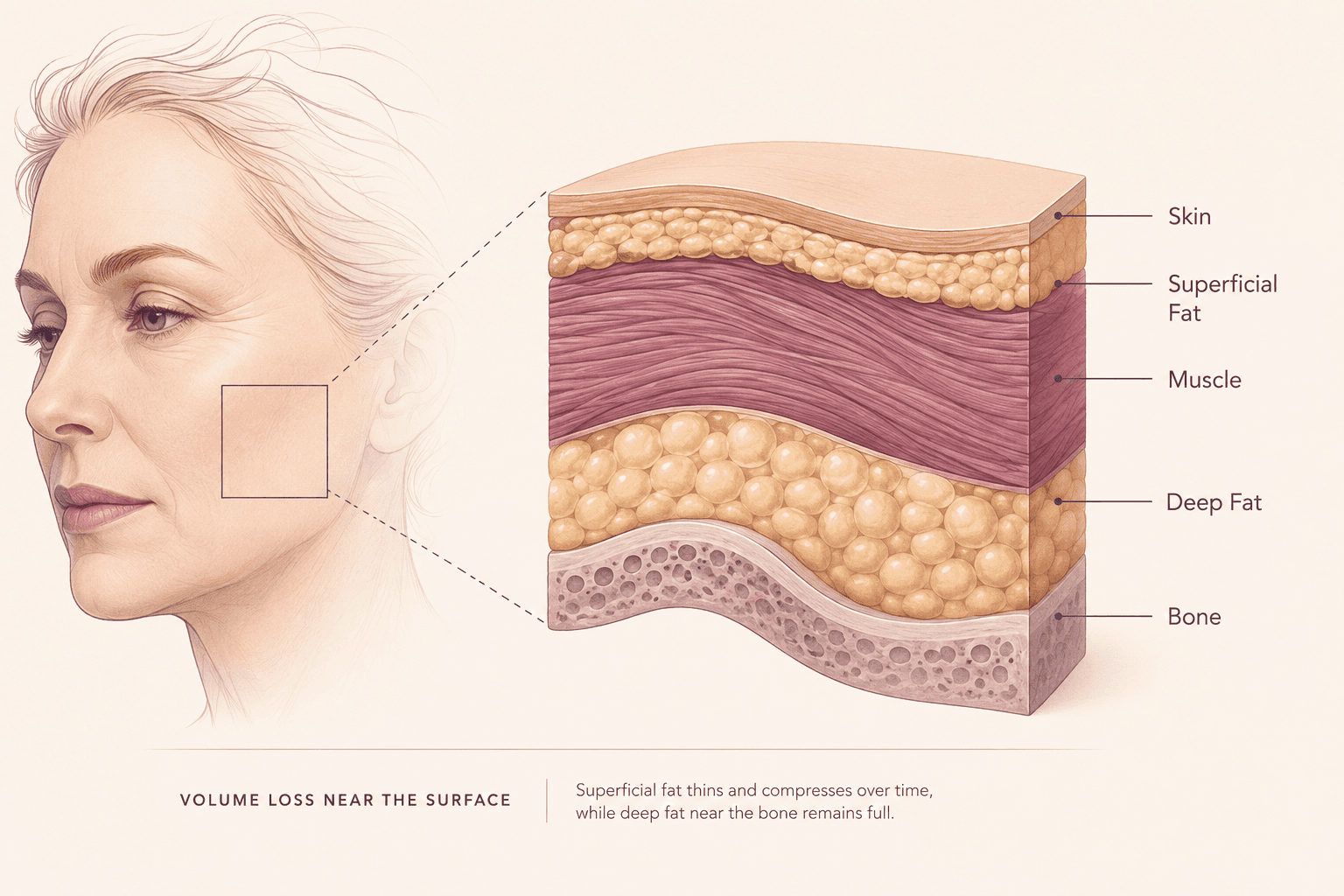
The fat you're losing sits directly under your skin, not deep against the bone. It was the cushion your skin rested on. That's why the change reads so fast in the mirror, and why no cream or device puts it back: the missing thing is fill, not firmness. One caveat, this was 20 patients, so treat 7% per 10 kg as an estimate.
GLP-1 face isn't one change, it's four
Three of these layers get discussed constantly. The fourth almost never does. In the body-composition substudy of STEP 1, roughly 40% of the weight lost was lean mass, per a 2024 Obesity Reviews analysis.
What you're seeing | What it actually is | What honestly helps |
|---|---|---|
Flat cheeks, hollow temples, shadow under the eyes | Lost volume, mostly superficial facial fat | Fillers, biostimulators, or fat grafting, placed by a clinician |
Softening and drape that shifts when you move or lie back | Laxity, skin quality plus some structure | Daily care and red light if it's mild; a clinician if it hangs |
Fine crinkling and papery texture across the cheeks | Crepiness, a skin-quality change | Daily barrier care plus red light, over weeks |
A face that reads flatter and less defined overall | Lost lean mass, including muscle, beneath the skin | Enough protein plus structured resistance training |
Four separate changes, four different answers. Most faces show a blend of all of them, and that's normal.
It differs by drug: in the SURMOUNT-1 substudy of tirzepatide, in Diabetes, Obesity and Metabolism in 2025, about 25% of the loss was lean mass. Lean mass isn't all muscle, and placebo groups lost it too, so this comes with weight loss generally. Still, some of what you're seeing is structure, not skin.
Why does it happen so fast?
Because the loss is large and quick, and it lands on skin already low on collagen. In STEP 1, in the New England Journal of Medicine in 2021, semaglutide produced a mean 14.9% body weight reduction over 68 weeks; SURMOUNT-1, same journal in 2022, showed 20.9% for tirzepatide. A 2022 review in Clinical and Experimental Dermatology notes nearly a third of dermal collagen goes in the first five years after menopause.
Speed seems to matter too. A 2026 international consensus in the Journal of Cosmetic Dermatology found more gradual loss may let skin accommodate better, though no trial has randomized people to fast or slow loss and measured their faces. A 2024 review in Aesthetic Surgery Journal Open Forum found those over 40 more susceptible. It's arithmetic, not a verdict on your skin.
When does GLP-1 face usually show up?
Honestly? Nobody knows, and we'd rather say so. No trial has followed people from day one and measured when the face changes. The closest anchor is that 2025 Vanderbilt cohort, where patients averaged 321 days on a GLP-1 and 11 kg lost when the median 9% change was measured. If you've read that it shows at twelve to twenty weeks, that traces back to commercial sites with no primary source.
In STEP 1, loss began at week 4 and bottomed out around week 60. So the model isn't a deadline, it's a slope running over a year or more. And no study has compared starting skin support early against late, so we won't pretend there's a right week to begin.
Why filling too early can work against you
Here's the finding that surprised us most, and it comes from the aesthetics literature rather than from us. A 2025 protocol in the Journal of Clinical and Aesthetic Dermatology recommends a staged approach, and the first stage explicitly isn't volume. At the start of a GLP-1 course you aren't at your final weight, so injecting filler then risks over-volumizing a face that's still deflating around it.
The staged approach, in plain terms
While you're still losing. Skin quality, not volume. Protein at 1.2 to 1.6 g per kg daily, per a 2025 four-society advisory in the American Journal of Clinical Nutrition, which is equally clear it won't preserve muscle without resistance training. Plus the AAD basics: ceramide moisturizer on damp skin, daily SPF 30+, and caution with retinoids, which can irritate skin that's turned dry on a GLP-1.
Every 4 to 5 kg. Take stock. What's changed is skin, and what's changed is volume? They move at different rates.
Once weight is stable. The window where volume decisions make sense, with a clinician who can see the finished shape.
We'd be lying if we said this wasn't convenient for us to point out, so take it from the source rather than the brand: a peer-reviewed protocol says the right early move is skin-quality work, not the needle. Demand isn't in doubt, mind. The American Society of Plastic Surgeons reported that in 2024, 41% of GLP-1 patients under member surgeons' care were considering nonsurgical procedures and 39% surgery. Timing is what's worth getting right, and we've broken down the honest price of every option.
Which of the four can red light actually touch?
Two of them, and only two. In 2025, a panel of 21 experts published an evidence-based consensus in the Journal of the American Academy of Dermatology, built on a systematic review and two Delphi rounds. It concluded that photobiomodulation is safe for adults and can be used for skin rejuvenation, graded at evidence level IB. That's the strongest affirmative case the category has.
The measured effects sit where you'd expect. A 2014 controlled trial in Photomedicine and Laser Surgery of 136 volunteers found better complexion, smoother skin, and increased collagen density on ultrasound. A 2023 study in Skin Research and Technology of an at-home red LED mask in 20 women aged 45 to 70 measured firmness improving 23.6% over twelve weeks.
Where we'd temper that
That 2023 study had 20 participants, no control group, and an author affiliated with the manufacturer. And a 2023 randomized trial in Photobiomodulation, Photomedicine, and Laser Surgery, across 137 women aged 40 to 65, cut wrinkle volume around the eyes by 31.6% but changed neither how hydrated nor how springy the skin was. Real effects, and specific ones.
What it honestly can't do
A 2023 trial in Medicine puts the limit plainly: these devices are not indicated as replacement therapy for loss of volume, facial contour, sagging skin, or deep wrinkles. Note too what that 2025 consensus lists as supported, skin rejuvenation and scars, and what it never lists: volume restoration or structural sag.
So here's the plain read. Two of the four changes, crepey texture and mild laxity, are skin-quality problems, and that's the layer red light is built for. Purpleglo is an FDA-cleared device made for exactly that work. The other two, lost volume and lost muscle, aren't ours to claim. If hollowing is your loudest change, a good injector is your answer. For the full habit stack, see our GLP-1 skin prevention stack; for texture, our guide to crepey skin after GLP-1 weight loss.
When to check with a professional
Most facial change after weight loss is completely normal. Still, it's worth speaking with a dermatologist or your healthcare provider if:
you're considering fillers, biostimulators, fat grafting, energy devices, or surgery and want your real options
you can't tell whether you're looking at volume loss, laxity, or texture, and want an expert read
you're worried about muscle loss, or you'd like your body composition properly measured
you notice a new lesion, a mole that changes, or anything that looks unusual
Your comfort and your health always come first.
You're not aging badly, your face is catching up
A face that looks older after you've done something genuinely good for your health is disorienting. It can feel like a punishment for succeeding. It isn't. It's a cushion receding, collagen running low, and some lean tissue going with the fat, faster than skin adapts.
None of that is a verdict on you, and once you've separated the four layers the path stops being vague. Volume is a clinician's job. Muscle answers to protein and resistance training. Skin quality is where consistent care and light do their real work. You did the hard part already. This is just the catching up.
Frequently asked questions
What is GLP-1 face (also called "Ozempic face")?
GLP-1 face, popularly called Ozempic face, is a lay term rather than a medical diagnosis. It describes the flatter, more hollow look some notice after rapid weight loss. A 2025 imaging study in Otolaryngology–Head and Neck Surgery measured a median 9% fall in midfacial volume, concentrated in the superficial fat just beneath the skin.
Is GLP-1 face the same as loose skin?
No. It's an umbrella term for several changes at once. Lost volume is fat gone from beneath the skin, reading as flatness and shadow. Loose skin is laxity, where skin drapes because it lost its fill. Crepey texture is a third, surface-level change. Each answers to a different fix, so naming yours matters.
When does GLP-1 face usually start?
There's no reliable week number, and any article giving you one is guessing. No trial has followed people from day one and measured when the face changes. The best anchor is a 2025 imaging cohort where patients averaged 321 days on a GLP-1 and 11 kg lost when a median 9% midface volume drop was measured.
Can red light therapy fix GLP-1 face?
Only part of it, and we won't claim otherwise. A 2025 consensus in the Journal of the American Academy of Dermatology graded photobiomodulation as supported for skin rejuvenation at evidence level IB. But dermatology literature is plain that these devices don't replace lost volume, facial contour, or sagging skin.
Can you prevent GLP-1 face while losing weight?
You can't prevent facial fat loss, but you can protect the layers around it. A 2025 joint advisory from four US nutrition and obesity societies recommends 1.2 to 1.6 g of protein per kg daily during weight loss, and stresses this won't preserve muscle without resistance training.
Sources
McCarthy AD et al. "Rising Public Interest in Weight Loss Medications and Growing Awareness of Their Aesthetic Sequelae: An Infodemiologic Google Trends Analysis and Clinical Diagnostic Patterning." Journal of Cosmetic Dermatology, 2026;25(1):e70670. Retrieved 2026-08-25. https://pubmed.ncbi.nlm.nih.gov/41521763/
Sharma RK et al. "Radiographic Midfacial Volume Changes in Patients on GLP-1 Agonists." Otolaryngology–Head and Neck Surgery, August 2025;173(2):360–366. Retrieved 2026-08-25. https://doi.org/10.1002/ohn.1209
KFF Health Tracking Poll. "1 in 8 Adults Say They Are Currently Taking a GLP-1 Drug." Published 14 November 2025. Retrieved 2026-08-25. https://www.kff.org/public-opinion/poll-1-in-8-adults-say-they-are-currently-taking-a-glp-1-drug-for-weight-loss-diabetes-or-another-condition-even-as-half-say-the-drugs-are-difficult-to-afford/
Wilding JPH et al. "Once-Weekly Semaglutide in Adults with Overweight or Obesity" (STEP 1). New England Journal of Medicine, 2021;384(11):989–1002. Retrieved 2026-08-25. https://www.nejm.org/doi/full/10.1056/NEJMoa2032183
Jastreboff AM et al. "Tirzepatide Once Weekly for the Treatment of Obesity" (SURMOUNT-1). New England Journal of Medicine, 2022. Retrieved 2026-08-25. https://www.nejm.org/doi/full/10.1056/nejmoa2206038
"Strategies for minimizing muscle loss during use of incretin-mimetic drugs for treatment of obesity." Obesity Reviews, 2024. Retrieved 2026-08-25. https://doi.org/10.1111/obr.13841
Look M et al. "Body composition changes during weight reduction with tirzepatide in the SURMOUNT-1 study." Diabetes, Obesity and Metabolism, 2025. Retrieved 2026-08-25. https://doi.org/10.1111/dom.16275
"Menopause, skin and common dermatoses. Part 2: skin disorders." Clinical and Experimental Dermatology, 2022. Retrieved 2026-08-25. https://doi.org/10.1111/ced.15308
"Managing Aesthetic Needs in Prescription Medication-Driven Rapid Weight Loss Patients: Results of an International Consensus." Journal of Cosmetic Dermatology, 2026. Retrieved 2026-08-25. https://doi.org/10.1111/jocd.70644
"Soft Tissue Facial Changes Following Massive Weight Loss Secondary to Medical and Surgical Bariatric Interventions: A Systematic Review." Aesthetic Surgery Journal Open Forum, 2024. Retrieved 2026-08-25. https://doi.org/10.1093/asjof/ojae069
"Aesthetic Considerations for Preventing and Managing GLP-1 Receptor Agonist–Related Facial Aging." Journal of Clinical and Aesthetic Dermatology, 2025. Retrieved 2026-08-25. https://jcadonline.com/aesthetic-considerations-for-preventing-and-managing-glp-1/
American Society of Plastic Surgeons. 2024 Plastic Surgery Statistics Report. Retrieved 2026-08-25. https://www.plasticsurgery.org/documents/news/statistics/2024/plastic-surgery-statistics-report-2024.pdf
Maghfour J et al. "Evidence-based consensus on the clinical application of photobiomodulation." Journal of the American Academy of Dermatology, August 2025;93(2):429–443. Retrieved 2026-08-25. https://doi.org/10.1016/j.jaad.2025.04.031
Wunsch A, Matuschka K. "A Controlled Trial to Determine the Efficacy of Red and Near-Infrared Light Treatment in Patient Satisfaction, Reduction of Fine Lines, Wrinkles, Skin Roughness, and Intradermal Collagen Density Increase." Photomedicine and Laser Surgery, 2014;32(2):93–100. Retrieved 2026-08-25. https://pmc.ncbi.nlm.nih.gov/articles/PMC3926176/
Couturaud V et al. "Reverse skin aging signs by red light photobiomodulation." Skin Research and Technology, 2023;29(7):e13391. Retrieved 2026-08-25. https://doi.org/10.1111/srt.13391
Mota LR et al. "Photobiomodulation Reduces Periocular Wrinkle Volume by 30%: A Randomized Controlled Trial." Photobiomodulation, Photomedicine, and Laser Surgery, 2023;41(2):48–56. Retrieved 2026-08-25. https://pubmed.ncbi.nlm.nih.gov/36780572/
"Comparison of the effects of 2 frequencies of application of photobiomodulation on facial rejuvenation: Controlled, randomized, and double-blind clinical trial." Medicine (Baltimore), 2023. Retrieved 2026-08-25. https://doi.org/10.1097/MD.0000000000032514
American Academy of Dermatology. "How can GLP-1 drugs affect my skin, hair, and nails?" Last updated 17 February 2026. Retrieved 2026-08-25. https://www.aad.org/public/everyday-care/skin-care-secrets/prevent-skin-problems/glp1-drugs-and-side-effects
"Nutritional priorities to support GLP-1 therapy for obesity: a joint Advisory from the American College of Lifestyle Medicine, the American Society for Nutrition, the Obesity Medicine Association, and The Obesity Society." American Journal of Clinical Nutrition, 2025. Retrieved 2026-08-25. https://ajcn.nutrition.org/article/S0002-9165(25)00240-0/fulltext


