
The GLP-1 Skin Prevention Stack: How to Protect Skin Quality While You Lose Weight
One cream will not save your face. A small stack of habits, started early, gives your skin the best chance to keep up with the scale.
10 min
read
In the STEP 1 trial published in the New England Journal of Medicine, adults on semaglutide 2.4 mg lost a mean of 14.9% of body weight over 68 weeks. That kind of change is a health win. It is also a skin stress test. Fat that once filled the face and body leaves faster than collagen and elastin can fully adapt.
This guide is the prevention stack we wish more people saw on day one: six layers that work together, plus where the Purpleglo red light mask honestly fits.
STEP 1 showed ~14.9% mean weight loss on semaglutide 2.4 mg (NEJM). Lean tissue can make up a sizable share of that loss without protein and training.
Stack pace, protein (about 1.2–1.6 g/kg), resistance work, hydration + SPF, barrier care, then collagen support.
Purpleglo supports firmness, texture, and tone in ~10 minutes a day. It does not restore lost facial volume.
This article is for education and support, not medical advice. Never change your medication, dose, or pace of weight loss on your own. Discuss protein targets, exercise, and any devices or supplements with your prescriber or a registered dietitian.
What is a GLP-1 skin prevention stack?
A prevention stack is a short list of habits you run together while weight is still moving. Each layer has one job. Pace buys time. Protein feeds collagen and muscle. Resistance training holds structure under the skin. Hydration and SPF protect what you still have. Barrier care keeps the surface calm. Red light supports collagen remodeling at home.
No stack stops every change. Facial volume loss is mostly a fat-pad story, not a cream story. What you can protect is skin quality: firmness, texture, crepiness, and tone. For a broader habit overview, see our guide on how to protect your skin during GLP-1 weight loss.
Why prevention beats rescue on a GLP-1
According to body-composition analyses discussed in Circulation and obesity reviews, a meaningful share of GLP-1 weight loss can come from lean mass, not only fat. When muscle and dermal support drop while fat pads shrink, skin can look thinner and looser sooner, especially after 40.
Cleveland Clinic clinicians describe “Ozempic face” as a cosmetic pattern of rapid weight loss: gauntness, sunken cheeks, new lines, and looser skin on the face and neck. It is not a formal diagnosis, and it is not unique to one drug. Starting support early is still the highest-leverage move, because collagen is easier to maintain than to rebuild.
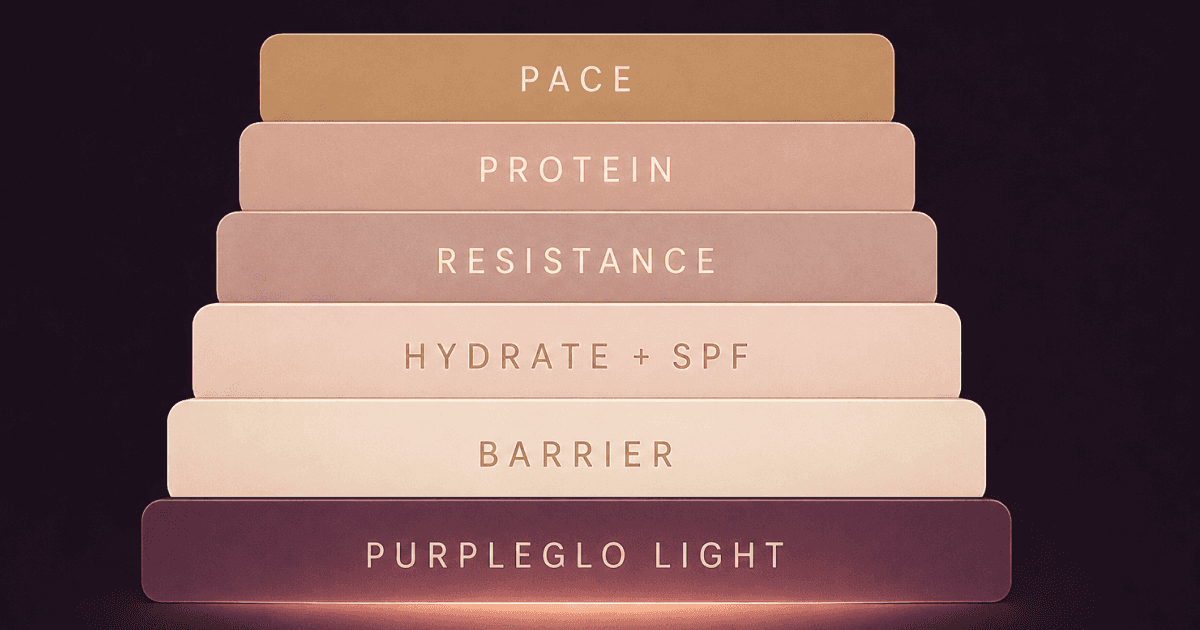
The 6-layer GLP-1 skin prevention stack
Use the layers in order of leverage. You do not need perfection on day one. You need consistency across months, which is the timescale skin actually works on.
Layer 1- Set a sustainable pace of loss
By the end of this step, you have a pace conversation with your prescriber, not a DIY dose plan. A more gradual loss, often described as about 1 to 2 pounds a week when clinically appropriate, gives skin more time to retract.
Faster loss tends to leave more crepey texture and visible laxity because the surface cannot shrink as quickly as the volume underneath. Your medical plan comes first. Ask about titration, protein, and side-effect management rather than skipping or cutting doses yourself.
Layer 2- Hit a daily protein target
By the end of this step, you know your gram target and how you will hit it when appetite is low. Obesity and sports-nutrition guidance commonly lands around 1.2 to 1.6 g of protein per kilogram of body weight per day during active loss.
For a 75 kg person, that is roughly 90 to 120 g a day. Spread it across meals. GLP-1s slow gastric emptying, so one giant protein dinner often fails. Think protein first at breakfast, lunch, and dinner, with a shake or Greek yogurt as a backup when nausea is high.
Layer 3- Hold muscle with resistance training
By the end of this step, you have 2 to 3 short resistance sessions on the calendar. Muscle is part of the structure your skin sits on. Protecting it helps the whole picture look firmer, not just the scale look smaller.
It does not need to be a gym identity. Bodyweight, bands, or light weights work if you train major groups and progress over time. Pair this with protein. Training without amino acids underfeeds the repair you are asking for.
Layer - Hydrate and wear SPF every day
By the end of this step, water and sunscreen are automatic. Well-hydrated skin looks plumper day to day. Daily SPF 30 or higher slows collagen breakdown from UV, which is the cheapest high-return habit on this list and the easiest to skip.
GLP-1 users often drink less because appetite and thirst cues quiet down. Keep a bottle where you sit. Apply SPF each morning to face, neck, and chest, rain or shine.
Layer 5- Keep the barrier calm
By the end of this step, your routine is simple enough to keep for months. Gentle cleanse. Moisturize morning and night. Add a retinoid only if your skin tolerates it and your clinician agrees.
Barrier stress shows up as dryness, tightness, and makeup that sits poorly. Support the surface while the deeper layers remodel. If you are sorting crepey texture vs volume loss, our hollow cheeks vs loose skin guide can help you name what you are seeing.
Layer 6- Support collagen with the Purpleglo red light mask
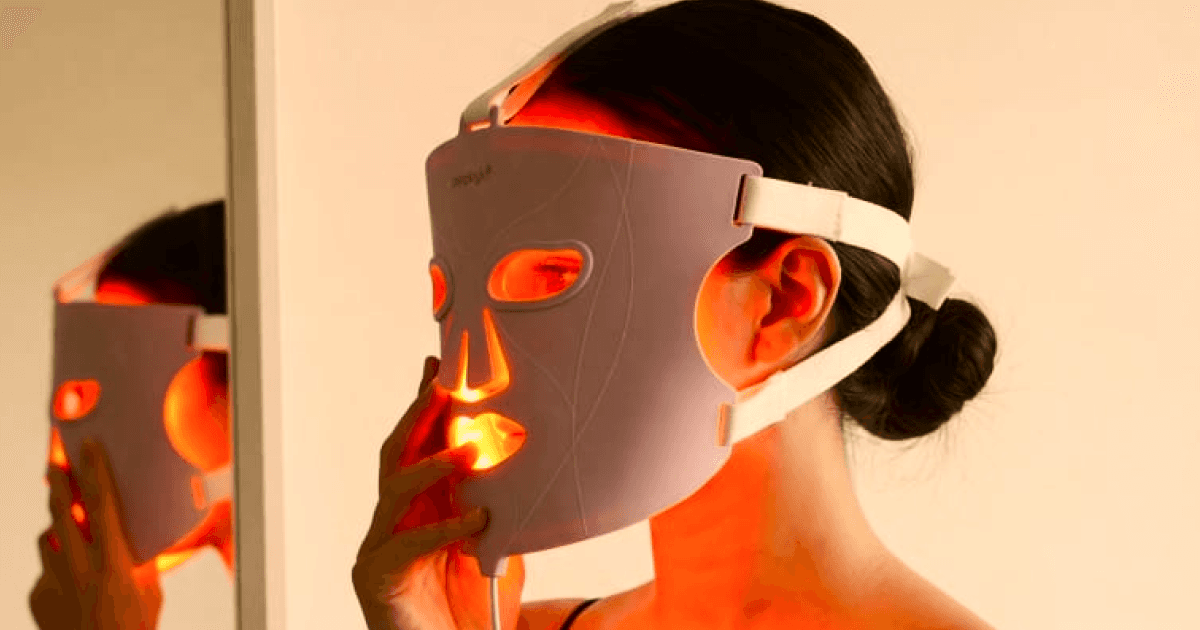
By the end of this step, red light is a short daily habit, not a rescue plan after the fact. Purpleglo is an FDA-cleared at-home LED mask built for the skin-quality layer people notice on GLP-1s: firmness, texture, crepiness, and tone.
216 LEDs across two clinically studied wavelengths: 630 nm red and 850 nm near-infrared
About 10 minutes a day, hands-free
Designed for consistency over intensity
Red light encourages the cells that help make collagen and elastin. Over weeks of steady use, that can show up as smoother, firmer-feeling skin. Most people notice hydration and smoothness first, with firmness and crepiness often shifting around weeks six to eight when they stay consistent.
What Purpleglo can support
Skin quality: firmness, texture, tone, and the crepey look that follows rapid loss. Ten minutes a day is enough when you keep showing up.
What Purpleglo cannot do
It will not restore lost facial fat pads, fix deep structural sag, or replace fillers or surgery. If volume is your main concern, we would rather tell you now and point you toward a clinician than overpromise.
Want a quick honesty check before you buy? Take the 30-second skin fit check. If Purpleglo is not the right tool for what you are seeing, the quiz says so.
How does a weekly prevention rhythm look?
Keep the week boring on purpose. Skin rewards repetition more than intensity. Here is a simple rhythm that covers every layer without turning your life into a clinic schedule.
When | What to do |
|---|---|
Every morning | Protein at breakfast, water nearby, moisturizer, SPF 30+ |
Every evening | Gentle cleanse, moisturizer, Purpleglo for ~10 minutes |
2–3 days / week | Resistance session (20–40 minutes) |
Weekly | Check in with yourself on pace, protein grams, and how skin feels |
With your provider | Dose, side effects, protein targets, and when aesthetics make sense |
A calm weekly rhythm for the GLP-1 skin prevention stack. Miss a day, restart the next. Consistency over months beats perfection for a week.
What the stack cannot prevent (and that is okay)
Even with every layer in place, some change is part of meaningful weight loss. Hollow cheeks and temple volume are often fat-compartment changes. Loose skin after large losses can need time, and sometimes procedures, after weight stabilizes.
That is not a failure of your stack. It is the honest boundary between skin quality and structure. Many clinicians prefer weight stability for a few months before major fillers or surgery so they are not treating a moving target.
When to talk to a professional
Most skin change during GLP-1 weight loss is expected. Still, check in with your provider or a dermatologist if:
you need help hitting protein without worsening nausea
you want a safer resistance plan for joints or energy
skin becomes itchy, painful, broken, or reacts and will not settle
volume loss or deeper sag is your main concern and you want clinical options
Prevention stack checklist
Pace conversation with your prescriber (no DIY dose changes)
Daily protein target written down (~1.2–1.6 g/kg)
2–3 resistance sessions scheduled
Water habit + SPF every morning
Simple barrier routine morning and night
Purpleglo red light mask ~10 minutes most days
Start the stack while the weight is still moving
You already did the hard part by choosing your health. The prevention stack asks for less heroism and more rhythm: protein, muscle, SPF, barrier care, and honest light. Start early. Keep it steady. Let your skin catch up on the same timeline as your body.
If you want the collagen-support layer done simply at home, Purpleglo was built for that job, and for telling you when it is not the right job.
Frequently asked questions
What is a GLP-1 skin prevention stack?
It is a small set of habits you run together during GLP-1 weight loss so skin has a better chance of keeping up. Core layers: sustainable pace, high protein, resistance training, hydration and daily SPF, barrier care, and consistent collagen support such as red light. No stack prevents every change, especially lost facial volume.
How much protein should I eat on a GLP-1 to protect skin and muscle?
Most guidance lands around 1.2 to 1.6 g of protein per kilogram of body weight per day during active loss. Protein supplies amino acids for collagen and helps preserve lean tissue. Because GLP-1s reduce appetite, many people need a protein-first plan at each meal. Confirm your target with your provider or dietitian.
Where does the Purpleglo red light mask fit?
In the collagen-support layer. Purpleglo is an FDA-cleared LED mask with 216 LEDs at 630 nm red and 850 nm near-infrared, used for about 10 minutes a day. It supports firmness, texture, crepiness, and tone. It does not restore lost facial fat or fix deep structural sag.
When should I start the stack?
As early as you can, ideally in the first weeks of treatment. Collagen and elastin are easier to support than to rebuild after skin has thinned. Starting protein, resistance work, SPF, barrier care, and red light early means your skin adapts alongside the weight change.
Can red light therapy prevent Ozempic face?
Not in the volume sense. Ozempic face is largely facial fat and soft-tissue loss from rapid weight reduction. Red light supports the quality of the skin that remains. Pair it with pace, protein, and muscle preservation, and see a clinician if volume restoration is your main goal.
Sources
Wilding JPH et al., “Once-Weekly Semaglutide in Adults with Overweight or Obesity” (STEP 1), New England Journal of Medicine, 2021. Retrieved 2026-08-12. https://www.nejm.org/doi/full/10.1056/NEJMoa2032183
Cleveland Clinic, “What Is ‘Ozempic Face’ and How To Prevent It.” Retrieved 2026-08-12. https://health.clevelandclinic.org/ozempic-face
Neeland IJ et al., “Muscle Mass and Glucagon-Like Peptide-1 Receptor Agonists: Adaptive or Maladaptive Response to Weight Loss?” Circulation, 2024. Retrieved 2026-08-12. https://www.ahajournals.org/doi/10.1161/CIRCULATIONAHA.124.067676
Locatelli JC et al., “Strategies for minimizing muscle loss during use of incretin-mimetic drugs for treatment of obesity,” Obesity Reviews, 2024. Retrieved 2026-08-12. https://onlinelibrary.wiley.com/doi/10.1111/obr.13841
Wunsch A, Matuschka K. “A Controlled Trial to Determine the Efficacy of Red and Near-Infrared Light Treatment…,” Photomedicine and Laser Surgery, 2014 (PMC3926176). Retrieved 2026-08-12. https://pmc.ncbi.nlm.nih.gov/articles/PMC3926176/
American Academy of Dermatology, “Red Light Therapy: Effective for Wrinkles and Other Signs of Aging?” Retrieved 2026-08-12. https://www.aad.org/public/cosmetic/safety/red-light-therapy
Purpleglo, LED Red Light Therapy Face Mask product page. Retrieved 2026-08-12. https://www.thepurpleglo.com/purpleglo/led-red-light-therapy-mask


